Could a generative model learn useful EMG structure from just one 200 ms example? This paper tested that possibility, examining both the statistics of the generated signals and their usefulness for gesture recognition.
We adapted SinGAN, a model developed to learn from a single image, to a time-frequency representation of multichannel EMG. The central question was feasibility: whether this small source example could support synthetic signals that add useful variation to a limited training set.
The question
Collecting more repetitions requires more effort from a participant. Synthetic signals could supplement those recordings, but visual resemblance alone cannot establish that they represent the same muscle activity.
The study therefore paired a statistical comparison with a held-out recognition test. Those assessments answer different questions: whether synthetic and recorded signals have similar properties, and whether adding synthetic signals helps the classifier used here.
The study at a glance
- Participants and recordings
- Ten intact-limbed participants; eight EMG channels sampled at 1,000 Hz.
- Task
- Six active hand/wrist gestures plus no movement; four repetitions of three seconds per class.
- Generator input
- The central 200 ms window of a repetition, converted to a multichannel time-frequency image.
- Assessment
- Feature-distribution comparisons and within-participant LDA recognition on held-out repetitions.
How we approached it
A short-time Fourier transform converted each selected window into a spectral image. The eight channels formed separate layers. SinGAN learned the structure of that individual example at multiple scales, then generated new spectral representations that were transformed back into time-series signals.
We compared real and synthetic recordings using four conventional time-domain features per channel. These capture amplitude and changes in the waveform, giving a more informative check than looking at traces alone. Principal component projections provided an additional view of the resulting feature distributions.
Technical detail: the evaluation
There were 280 source models: ten participants, seven classes, and four repetitions. The study generated 1,000 examples per model at each of three generation levels.
In the augmentation test, LDA was trained with one real repetition, or with that repetition plus synthetic examples derived from it. Other repetitions supplied testing data. The experiment did not replace the entire classifier-training set with one 200 ms recording.
What we found
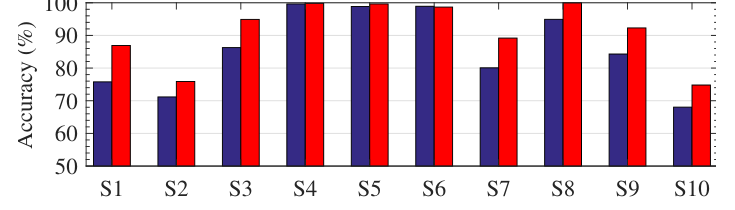
Augmentation increased mean recognition accuracy from 85.8% to 91.2%, a gain of 5.4 percentage points, in the reported LDA comparison. The difference was statistically significant at p < 0.001. This result supports usefulness for the selected limited-data training scenario.
Signal fidelity was less complete. The generated traces were smoother, and features sensitive to higher-frequency variation—notably zero crossings and slope sign changes—were harder to reproduce. Multivariate distribution tests rejected equality for all 280 comparisons at every generation level.
Real repetitions also differed statistically from each other, so rejecting equality is not by itself evidence that generated data are unusable. Conversely, an accuracy increase does not make the synthetic distribution equivalent to real EMG. The two results need to be read together.
Reading the figures
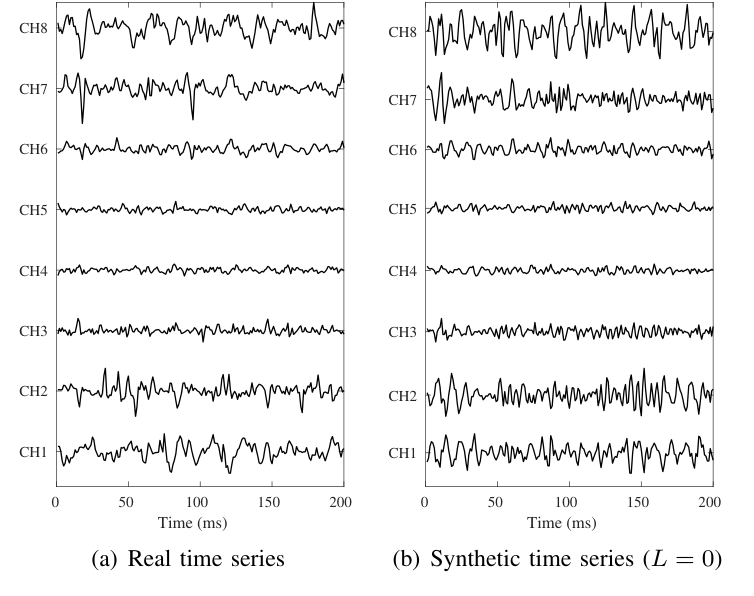
Each horizontal trace corresponds to an EMG channel, with time on the horizontal axis. The example on the right was generated at the lowest generation level and retains recognizable channel-to-channel amplitude structure.
The smoother oscillations are also visible. This makes the figure useful for explaining why the feature tests found differences in waveform variation despite broadly similar-looking channel patterns. It is an example, not a substitute for the distribution analyses.
The augmentation result can be inspected participant by participant. Blue bars use the regular training data; red bars add the generated examples. This is the downstream classification experiment, rather than a direct measure of signal realism, and the average gain should be read alongside the differing starting accuracies.
What the results do not establish
The recordings used a fixed position and intensity, and the classifier evaluation involved held-out repetitions from the same participants. The results do not establish cross-user, cross-session, or dynamic-condition benefits.
Each generator depends on one selected window. A window that poorly represents its repetition may produce unhelpful synthetic examples. The success of LDA augmentation also does not establish that every classifier will benefit, or that generated signals are suitable for physiological interpretation.
Looking back
The feasibility result is strongest when stated precisely: a generator trained on a brief spectral example produced variation that helped the tested gesture classifier, while missing some real-signal statistics.
A focused follow-up would compare source-window selection and alternative time-frequency representations, measuring both spectral fidelity and held-out recognition. Testing several classifiers under the same real-data budget would establish how much the augmentation benefit depends on the downstream model.
Read further
Evan Campbell, James A. D. Cameron, and Erik Scheme. Feasibility of Data-Driven EMG Signal Generation Using a Deep Generative Model. 42nd IEEE EMBC, pp. 3755–3758, July 2020. DOI: 10.1109/EMBC44109.2020.9176072.
The methods describe the spectral conversion and generation levels. The statistical tests, principal component plots, and classification results should be read together. Campbell and Cameron contributed equally.