How reliably can a wake gesture distinguish an intentional request for control from the muscle activity of daily life? This journal paper evaluates finger-snap mode switching during two online tasks and examines the cost of conservative detection.
This is the published version related to the 2024 on-demand-control preprint. The shared experiment should be read as one body of evidence. Here the discussion centres on the online detection measures and the user experience of missed or unintended mode changes.
The question
A wake detector solves a different task from the gesture classifier it enables. Its output is whether to enter or leave active mode; the underlying classifier then determines the command.
The study asked whether a temporal finger-snap detector could keep that gate closed during everyday activity and open it reliably when requested. It also asked which kind of error users found more disruptive: repeating an intended snap or correcting an unintended activation.
The study at a glance
- Participants
- Twenty people aged 20–31; two excluded from the principal confusion-matrix analyses.
- Wake recognition
- Twenty personal snap templates, root-mean-square features, and dynamic time warping.
- Activities
- Walking, typing, writing, simulator driving, and phone use.
- Intentional tasks
- Snap to enable control, dismiss an alarm or navigate a Sphero robot, then snap to disable control.
How we approached it
The device continuously recorded eight EMG channels. The wake detector compared one-second sequences with the personal templates, while a separate five-class LDA recognizer supplied application commands when enabled.
Intentional snaps and missed responses were counted during the experiment. Negative opportunities were computed afterward from the recorded decision stream. Seven alternative gestures were also collected for an offline analysis of possible wake signals, but were not substituted into the live task.
Technical detail: the evaluation
True-positive and false-negative rates describe attempted snaps. False-positive and true-negative rates describe opportunities for unintended detection in the sliding decision stream. Their denominators are different.
The reported main analysis excluded one participant with 141 missed snaps and another with seven false positives. Those exclusions need to accompany the headline detection rates. The full experiment’s experience includes those failures even when they are omitted from a summary matrix.
What we found
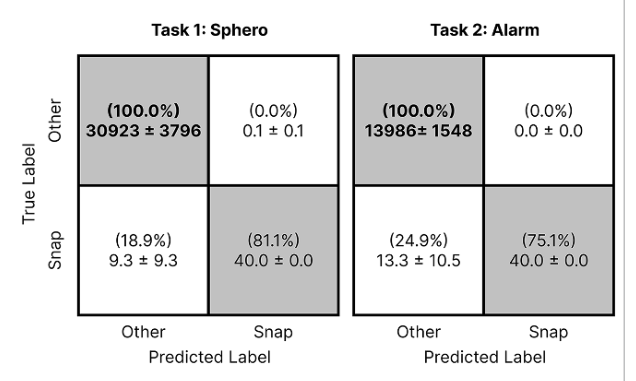
The system ignored more than 99.9% of evaluated non-target activity and had a median false-positive rate of zero. Eighteen of twenty participants experienced no false positives, but the participant with seven unintended toggles demonstrates why “eliminate” in the title should not be read as a guarantee for every person.
The reported missed-snap rates were 18.9% in the robot task and 24.9% in the alarm task, corresponding to true-positive rates of 81.1% and 75.1%. The difference suggests that the circumstances in which the user invokes the wake gesture affect repeatability.
Participants generally preferred an occasional missed activation to an unintended one, while consecutive missed attempts were frustrating. The alternative-gesture analysis suggested possibilities for further testing, but the paper explicitly stops short of claiming established online generalization to those gestures.
Reading the figures
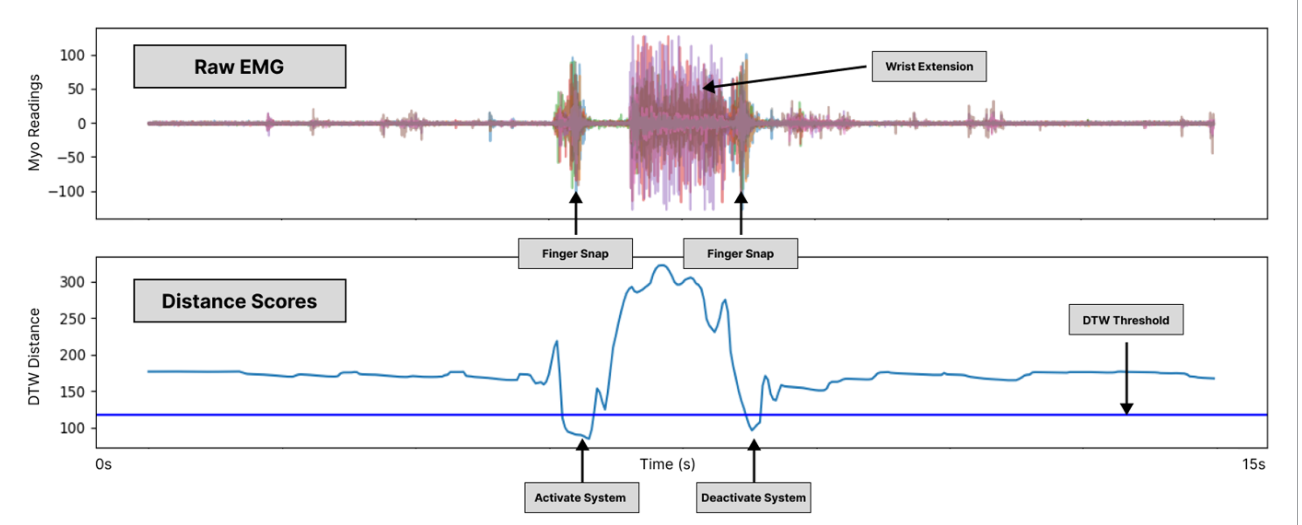
The upper plot shows the recorded muscle activity; the lower plot shows template distance. When the distance falls below the chosen threshold during a snap, the system toggles its state.
The intervening wrist-extension contraction is a command for the active classifier rather than another wake event. This example illustrates separation between mode switching and control, without implying that all recordings have equally clear separation.
The journal confusion matrices make missed intentional input visible alongside suppression of out-of-set activity. The two tasks have different snap-detection rates, and values rounded to 100% for other activity are not a guarantee of zero false activation in unrestricted use. These are the same experimental data discussed in the preprint entry.
What the results do not establish
The sessions sampled five activities in a laboratory setting. They do not establish a lifetime false-activation rate or robustness under different placements, prolonged fatigue, or changing sensor contact.
The main-result exclusions, personal calibration, and accessibility of snapping all limit generalization. The study did not test limb-loss prosthesis locking, even though the discussion proposes it as a possible application.
Looking back
The value of this paper is a measured account of both sides of wake gating. Non-target rejection alone would hide the repeated attempts required from some users; mean acceptance alone would hide the disruption caused by a few unintended toggles.
A focused continuation would report all-participant event rates per hour, consecutive missed attempts, and user-adjustable operating thresholds over multiple days. Testing personally selected wake gestures online would address the accessibility question left open here.
Read further
Ethan Eddy, Evan Campbell, Scott Bateman, and Erik Scheme. EMG-Based Wake Gestures Eliminate False Activations During Out-of-Set Activities of Daily Living: An Online Myoelectric Control Study. Journal of Neural Engineering 22, 016006, January 17, 2025. DOI: 10.1088/1741-2552/ada4df.
Sections 3.2–3.4 give the detection counts, exclusions, alternative-gesture analysis, and user feedback. Section 4.1 discusses the false-positive/false-negative tradeoff.