A regression model needs more than the name of a contraction: its training labels also describe how the intended output changes over time. This paper asks what happens when the participant’s contraction does not follow that prompted trajectory.
We first examined behaviour under three visual prompting styles, then tested two observed behaviours in a small online-control experiment. The focus was the relationship between prompt compliance, training labels, and the usability of the fitted model.
The question
Visual prompting assumes that a participant follows both the direction and amplitude of a moving target. A person can perform the requested movement but start its opposite too soon, or skip the gradual changes in effort that the labels prescribe.
The study asked whether such behaviours could be observed consistently enough to investigate and whether they affected subsequent control. It did not begin by assuming that the prompt was a direct measurement of actual muscle effort.
The study at a glance
- Overall sample
- Eight participants across two overlapping pilot phases.
- Prompt comparison
- Five participants followed anthropomorphic, bar-plot, and Cartesian visualizations.
- Behaviour experiment
- Six participants deliberately emulated anticipation, all-or-nothing activation, and a best-effort baseline.
- Control evaluation
- Two-degree-of-freedom target acquisition; three participants used linear SVR and three used radial-basis-function SVR.
How we approached it
High-density EMG was recorded with the 64-channel EMaGer cuff. The prompting experiment covered hand opening/closing and forearm pronation/supination, with gradual ramps and steady portions.
The analysis used mean absolute value across channels as an approximate indicator of contraction strength. Two behaviours emerged: anticipating the next direction before the prompt reached neutral, and making abrupt changes instead of following gradual intensity ramps.
In the second phase, participants were coached to exaggerate these patterns so their potential effects could be examined. Models trained under each behaviour were then used in a ten-trial Fitts-style task.
Technical detail: the evaluation
The second phase tested the observed behaviours, not the three visualization styles directly. The nonlinear and linear models were used by different groups of three participants, so a model comparison is also influenced by participant differences.
Both models used a 0.25 deadzone to suppress small outputs. This setting is part of the tested controller and affects how errors near neutral translate into drift or movement.
What we found
Anticipation produced activity associated with the next direction while the prompt still labelled the previous direction. The mismatch was especially relevant near neutral, where reliable quiescence is needed.
In the deliberately exaggerated anticipation condition, twenty-four of thirty target trials timed out with the linear support vector regressor. The all-or-nothing condition also degraded linear-model control, but less severely. The nonlinear radial-basis-function model appeared more resilient in the small group that used it.
The timeout count is more informative here than computing throughput only for successful trials. Most anticipation trials with the linear model were not completed, so their other performance metrics cannot be compared fairly as if all trials had produced valid values.
Reading the figures
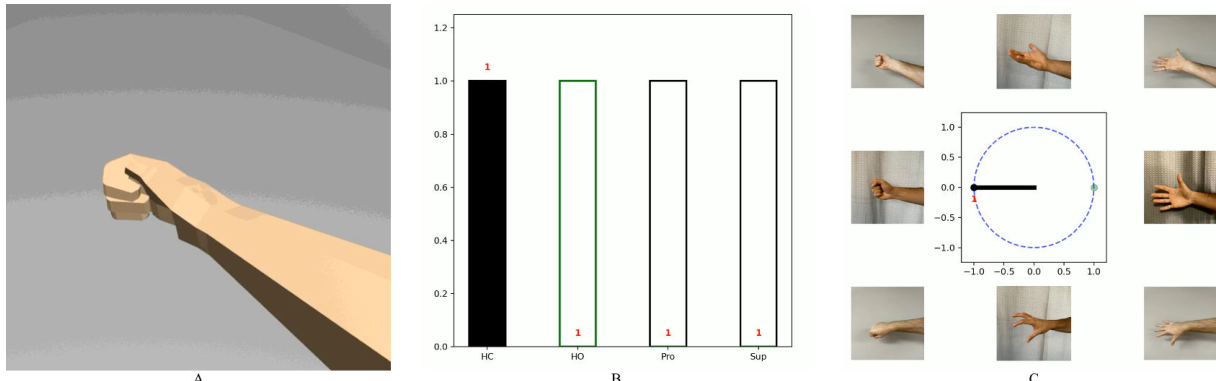
The three panels communicate a similar desired progression through different visual forms. One uses a virtual limb, another shows activation levels, and the third maps direction and intensity into a spatial target.
The relevant question is how the participant translates that display into muscle activity over time. The later EMG plots, rather than the appearance of the displays alone, provide evidence of anticipation and abrupt activation.
The behaviour experiment compares completion, throughput, efficiency, and overshoot under the deliberately elicited training behaviours. The low linear-model completion rate in the anticipation condition is especially visible. These results characterize the tested behaviours and kernels; they do not estimate how frequently users naturally behave this way.

What the results do not establish
These are small, exploratory experiments. The coached behaviours were intentionally exaggerated and do not estimate how often severe errors occur during ordinary calibration.
Mean absolute value is an approximate signal-based indicator, not an independent force measurement. The different participant groups also prevent a strong conclusion that nonlinear regression is generally immune to these behaviours or that one visualization is universally preferable.
Looking back
The focused contribution is to question the assumed correspondence between a displayed regression label and the contraction recorded beside it. The consequences are particularly concrete near neutral and during changes in direction.
A larger within-participant comparison could test all models with the same naturally elicited training data. Measuring actual movement or force where possible would help separate timing errors, intensity errors, and limitations of EMG as a proxy for compliance.
Read further
Christian Morrell, Evan Campbell, and Erik Scheme. Exploring User Compliance in the Training of Regression-Based Myoelectric Control. Myoelectric Controls Symposium (MEC24), August 15, 2024. DOI: 10.57922/mec.2507.
Figures 1–3 distinguish prompting styles from observed and deliberately emulated behaviours. The online results report noncompletion under anticipation; the discussion frames these as pilot findings.