Can a temporal model learn useful control dynamics when contextual training labels are slightly misaligned with what the person actually does? This paper combines a transformer, online contextual learning, and a loss that tolerates timing differences.
We evaluated two-degree-of-freedom cursor control at three target sizes. The focus was whether temporal adaptation could improve precision as well as speed, especially where conventional regression controllers struggled to acquire and remain within small targets.
The question
Contextual labels infer suitable actions from the task, but the person may anticipate, delay, or briefly pause a movement. Point-by-point training can penalize a plausible output merely because its timing differs from the inferred trajectory.
The study asked whether learning sequences with soft dynamic time warping (sDTW) could accommodate those deviations. It also tested whether a transformer’s ability to model temporal structure was useful when trained only on conventional calibration recordings.
The study at a glance
- Participants
- Twelve intact-limbed adults, each completing one approximately two-hour session.
- Signals
- Eight-channel gForcePro+ EMG at 1,000 Hz; wavelet-energy features.
- Pipelines
- Static MLP, static transformer, MLP with CIIL, and transformer with sDTW-based CIIL.
- Evaluation
- Two-degree-of-freedom velocity control; sixteen target acquisitions at each of three target sizes, with a two-second dwell.
How we approached it
All pipelines began with screen-guided calibration containing isolated wrist movements. The adaptive pipelines subsequently received examples labelled from the relationship between their predictions and the target. Context allowed partially suitable directions and excluded examples where no reliable interpretation was available.
The MLP learned individual feature windows. The transformer used the ten most recent windows, giving it approximately half a second of temporal context. During adaptation, its sDTW loss compared output and pseudo-label trajectories while allowing a flexible temporal alignment.
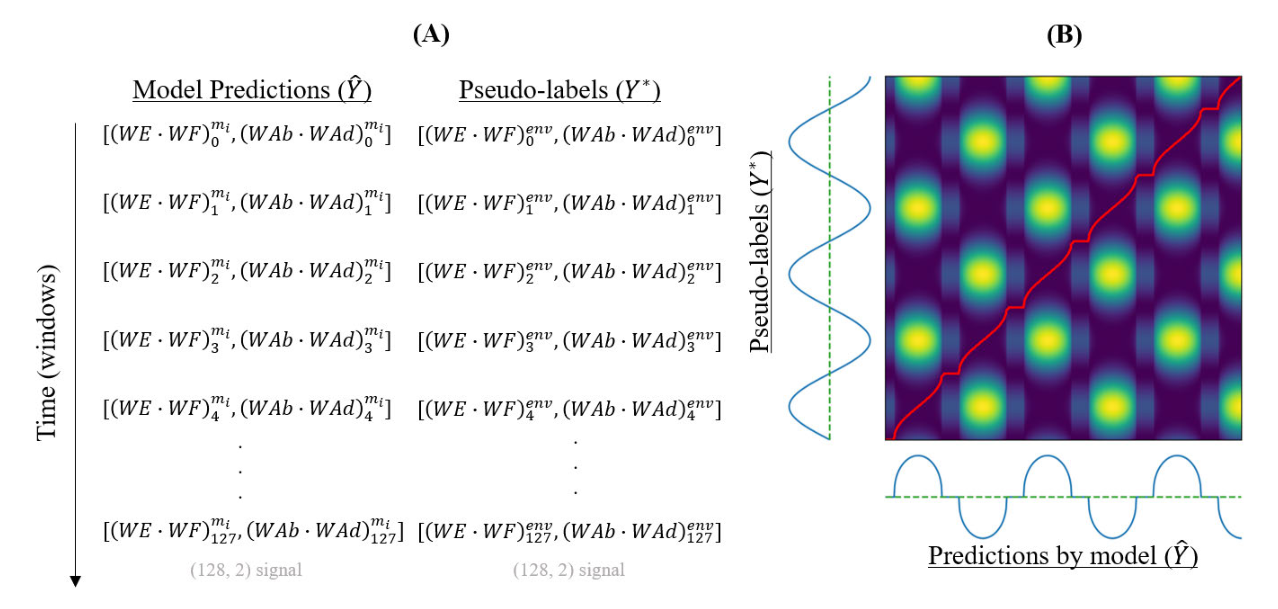
This separates two horizons: the short recent history used to make a prediction and the longer sequences used to calculate the adaptation loss. Temporal alignment is a training operation; it does not mean waiting for a complete future user movement before producing an output.
Technical detail: the evaluation
The features came from 100 ms windows advanced every 40 ms. The transformer embedded each 64-dimensional window into sixteen dimensions and used four attention layers. The sDTW training comparison used sequences spanning 128 windows.
The four pipelines provide useful contrasts, but there was no adaptive transformer trained with ordinary pointwise loss. Consequently, the study does not isolate the entire incremental benefit of sDTW from that of temporal adaptation itself.
What we found
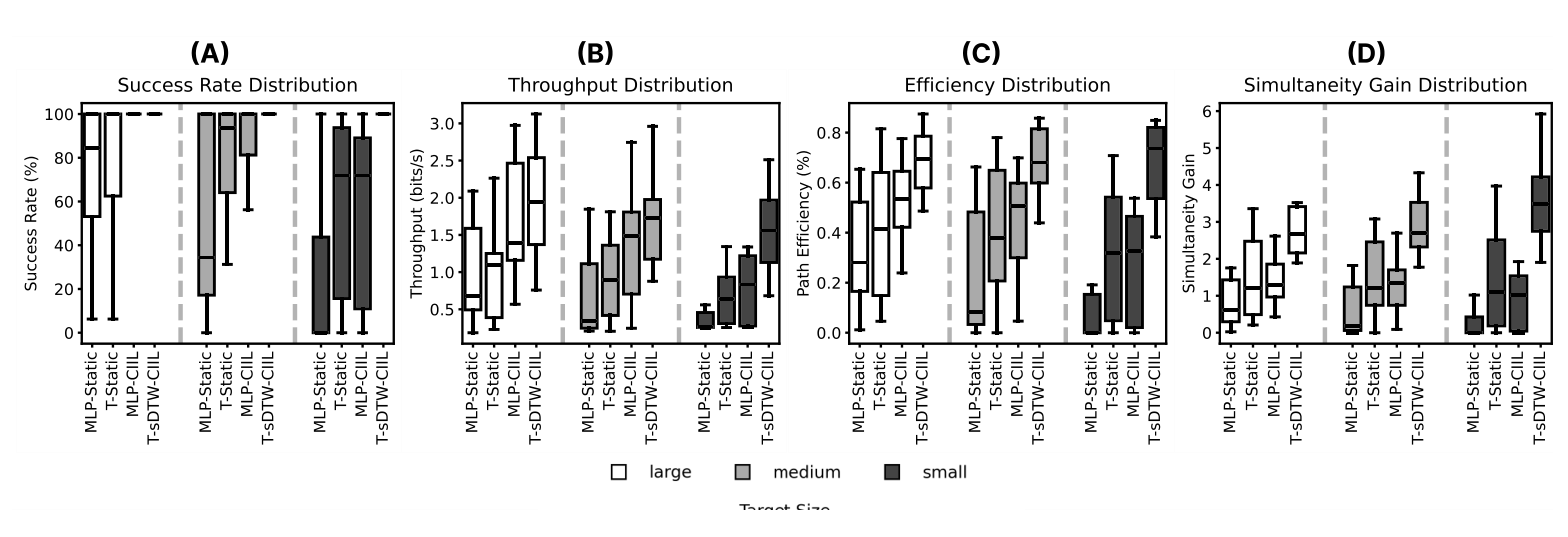
At the smallest target size, the combined pipeline achieved 98.4% success, compared with 57.8% for MLP-CIIL, 55.2% for the static transformer, and 23.4% for the static MLP. The small-target comparisons were significant and directly support the precision-focused claim.
Across target sizes, mean throughput for the combined pipeline was 1.75 bits/s and significantly exceeded all three comparators. Its throughput advantage over adaptive MLP was significant for small targets, but not for the large and medium targets. That condition-specific result is more precise than claiming every pairwise comparison improved.
The static transformer fit the calibration trajectories well but did not significantly improve overall online throughput over the static MLP. The study therefore supports the combination of temporal modelling and appropriate online learning, rather than an architecture-only advantage.
The paper also reports lower contraction intensity after adaptation. This is a measured signal-level outcome; reduced fatigue over prolonged use remains a proposed implication rather than an established endpoint.
Reading the figures
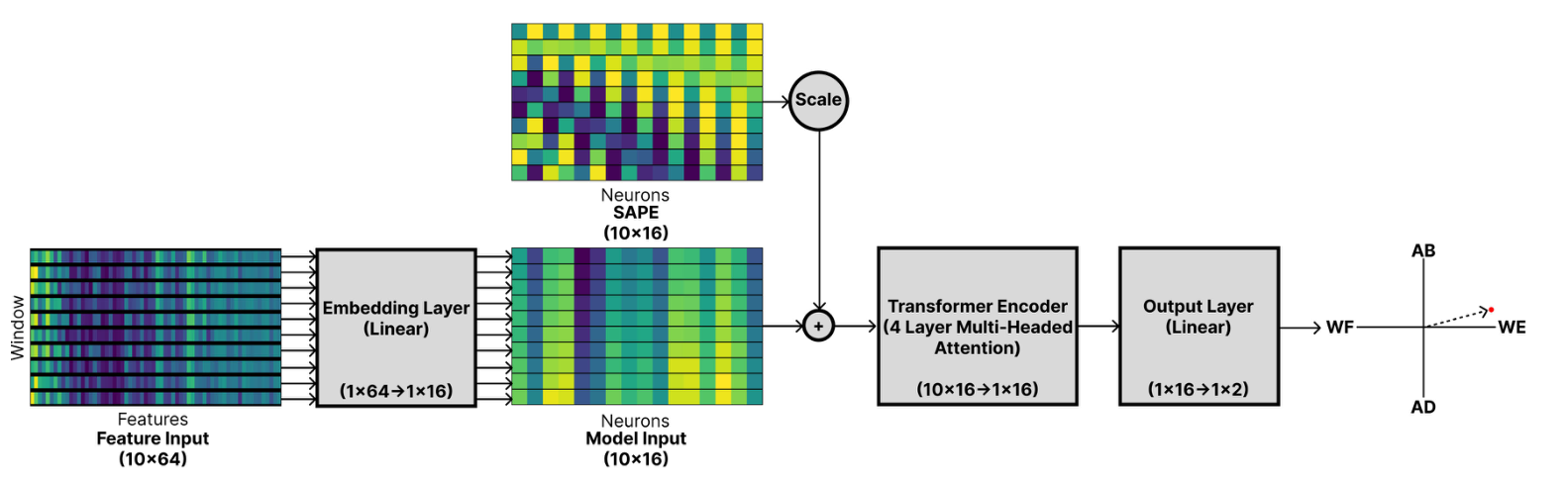
Rows represent recent feature windows. The embedding and positional information let the attention layers operate over their temporal order, and the final output predicts the two cursor-control components.
This figure explains the prediction architecture. Figure 4 in the paper separately explains how sDTW aligns trajectories during training; the two operations should not be conflated.
The alignment diagram explains the training operation that the architecture diagram leaves out. Predicted and pseudo-labelled trajectories form sequences, and the alignment accommodates timing differences during loss calculation. This is a training comparison over trajectories, not a requirement to wait for a future movement before issuing a prediction.
The target-size distributions show where the precision claim comes from. The dark small-target condition separates the pipelines most clearly, particularly for success rate. Keep the target-size-specific comparisons in view rather than extending the overall throughput advantage to every pairwise comparison at every size.
What the results do not establish
The experiment used intact-limbed adults, a fixed laboratory task, and short calibration and adaptation periods. It does not establish retention across days, clinical prosthesis performance, or reliable learning from imperfectly observed real-world goals.
sDTW also cost more computation than pointwise error. The paper reports approximately one second versus 0.2 seconds per epoch for each minute of accumulated data on the study setup. That is adaptation cost, not the latency of every cursor prediction, but it matters for wearable deployment.
Looking back
The study’s focused contribution is strong small-target control from a pipeline that learns temporal behaviour while tolerating label timing differences. Keeping the static-transformer and adaptive-MLP comparisons visible clarifies which simpler changes were insufficient.
A direct next experiment would add the missing adaptive-transformer pointwise-loss condition and vary intentional label delay. That would test the specific contribution of alignment tolerance. Repeated-session evaluation would then address whether the learned precision persists beyond the original task session.
Read further
Evan Campbell, Ethan Eddy, and Erik Scheme. Transformer-Based Context-Informed Incremental Learning With sDTW Alignment Unlocks Fast and Precise Regression-Based Myoelectric Control. IEEE Transactions on Neural Systems and Rehabilitation Engineering 34, pp. 2118–2129, April 17, 2026. DOI: 10.1109/TNSRE.2026.3685074.
Figures 3–4 distinguish the transformer architecture and sDTW learning. Tables I–IV and the target-size comparisons report precision and throughput; the final discussion covers computation and longitudinal limits.