Can a person and an initially untrained myoelectric model develop a usable mapping through a goal-directed task? This paper tests that possibility against conventional screen-guided calibration and calibration followed by adaptation.
We evaluated how each pipeline supported online target acquisition and how it classified separately prompted gestures. The key question was whether learning from actual control behaviour could produce a better working interface, even when it did not reproduce the original calibration labels as closely.
The question
Screen-guided training supplies clean labels for prescribed gestures, but a person controlling a cursor also makes corrections, changes effort, and seeks stability near a target. Those behaviours can differ from the calibration recordings.
The study asked whether contextual learning could begin without a pretrained mapping and become usable within a practical training interval. It also examined the speed mapping that converts contraction intensity into cursor movement.
The study at a glance
- Participants
- Sixteen intact-limbed participants, from novice to experienced myoelectric users.
- Hardware
- Eight-channel gForcePro+ armband at 1,000 Hz; wavelet-energy features from 200 ms windows.
- Pipelines
- Screen-guided training alone (SGT), SGT plus adaptation, and adaptation from random initialization.
- Outcomes
- Fitts-style throughput, adaptation trajectories, offline classification, and proportional-speed behaviour.
How we approached it
Context supplied potentially suitable movement directions during gameplay. Neural-network training could use soft targets when several actions were plausible, rather than pretending every contextual label was certain. Label spreading and a Gaussian mixture model further refined the accumulated examples.
The controller also adapted its relationship between contraction intensity and speed. A sigmoid mapping provided a low-speed region for fine adjustment and a high-speed region for travel. This was part of the adaptive pipeline, so the final outcome reflects more than classifier-boundary learning alone.
Technical detail: the evaluation
The from-scratch condition is called zero-shot adaptation in the paper. It starts without prior calibration, but then learns from the user during the task. It should not be confused with a fixed pretrained zero-shot model that works immediately without adaptation.
Gameplay continued for 600 seconds. The final throughput comparison follows that experience; reaching competitive performance at around 200 seconds does not mean the final score was already achieved at that time.
What we found
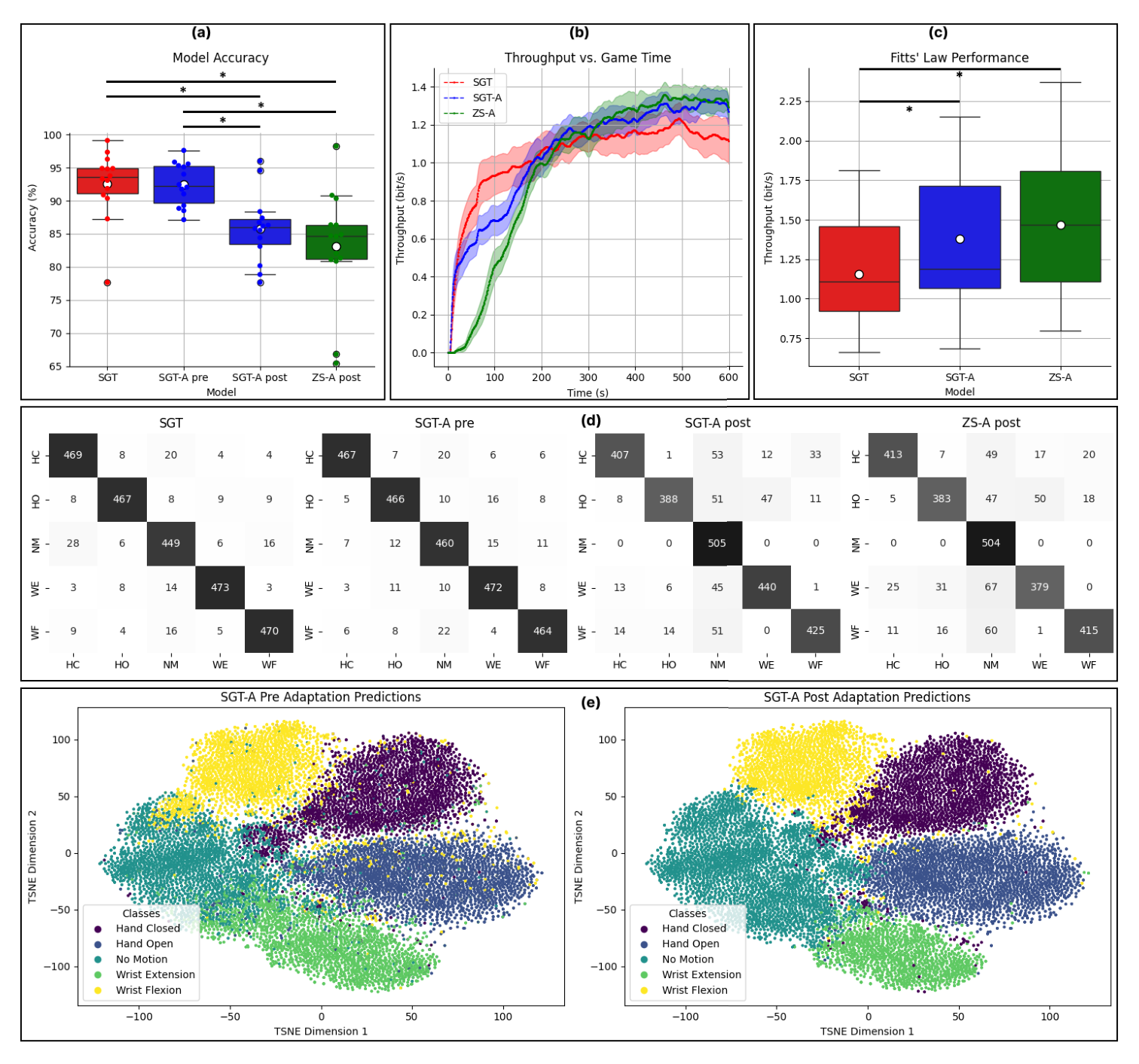
The from-scratch model reached mean final throughput of 1.47 ± 0.46 bits/s, significantly above the SGT baseline’s 1.15 ± 0.37 bits/s. SGT followed by adaptation reached 1.38 ± 0.45 bits/s; its difference from the from-scratch condition was not significant.
The initially random model began with very poor control but became competitive with the other conditions at approximately 200 seconds. It continued to improve afterward. This trajectory is central to assessing the initial interaction burden.
Offline accuracy moved in the other direction: SGT achieved 92.4%, while the final adapted-from-SGT and from-scratch models achieved 85.8% and 83.1%. The analysis associated some differences with expanding the rest region around uncertain low-amplitude inputs. In this experiment, closer reproduction of prompted labels did not identify the best online controller.
Reading the figures
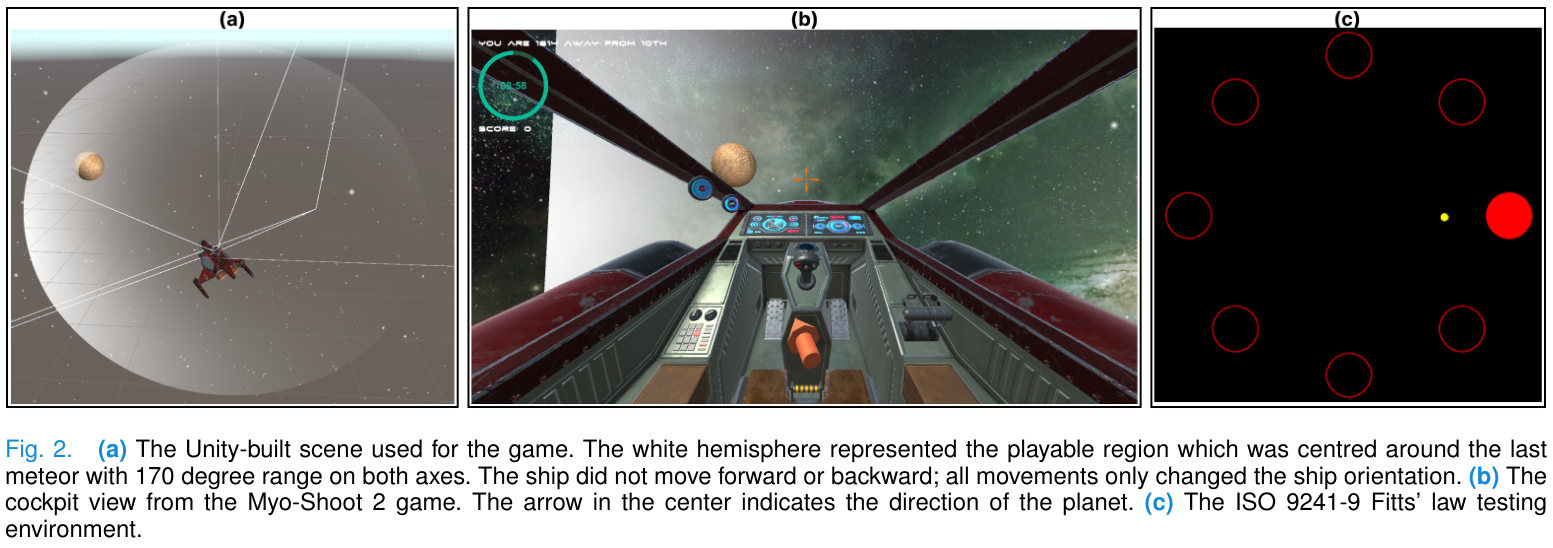
The gameplay panels show the goal-directed environment that generated adaptation examples. The target-acquisition panel shows the separate evaluation used to measure the resulting control.
Keeping those roles distinct helps interpret the study: learning occurred while pursuing game goals, and the fitted mapping was then assessed through a structured movement task.
The upper row contrasts recorded-data accuracy, adaptation over game time, and final target-acquisition performance. The lower panels inspect how predictions change in feature space. Reading them together explains why fitting the original screen-guided labels was not equivalent to better goal-directed control; the illustrated projections are diagnostic views, not additional participants.
What the results do not establish
This was a short laboratory study with intact-limbed participants and accessible task context. It does not establish immediate usability from random initialization or clinical effectiveness for prosthesis control.
Classifier adaptation, label refinement, user learning, and proportional-speed adaptation all contribute to the system. The main pipeline comparison does not isolate each component’s causal contribution. Nor does the observed offline–online divergence mean offline accuracy is never informative.
Looking back
The specific finding is that a mapping learned around the user’s task behaviour can support better control than one optimized only for prompted gestures. The learning curve and initial period of poor performance are part of that account.
A focused continuation would ablate the label-refinement and speed-mapping components while measuring time to usable control. Transferring the resulting mapping to another task would then test how much of the benefit is specific to the original environment.
Read further
Evan Campbell, Ethan Eddy, Xavier Isabel, Scott Bateman, Benoit Gosselin, Ulysse Côté-Allard, and Erik Scheme. Screen Guided Training Does Not Capture Goal-Oriented Behaviors: Learning Myoelectric Control Mappings From Scratch Using Context Informed Incremental Learning. IEEE Transactions on Neural Systems and Rehabilitation Engineering 33, pp. 332–342, Online December 16, 2024; volume 2025. DOI: 10.1109/TNSRE.2024.3518059.
Figure 5 compares accuracy, throughput, and learning trajectories. Figure 6 examines proportional control. The publication appeared online in 2024 and in the 2025 volume.