A classifier can recognize a gesture in the laboratory and struggle with the same gesture after the user changes position, grips an object, or puts the sensor on again. The label is unchanged; the measurement is not.
This chapter reviewed the signal-processing pipeline for surface electromyography (EMG), with particular attention to the conditions that make an apparently successful system unreliable in practice. Its organizing question was how to preserve useful control when the signals encountered during use differ from those collected for training.
The question
Pattern recognition assumes that useful regularities connect a signal to an intended action. A person repeats a gesture during training, and the system learns to recognize similar recordings later. The difficulty is deciding which kinds of ‘later’ the training data represent: another repetition, another hour, a different arm position, or a completely new user.
These changes arise for different reasons. Electrical interference corrupts a measurement. A stronger contraction changes muscle recruitment. Moving the arm changes the mechanical task and the relationship between muscles and electrodes. A new user brings differences in anatomy and behaviour. Treating all of them as one generic accuracy problem hides the choices needed to investigate them.
The chapter connected those practical questions to the familiar processing stages. It also extended the discussion beyond hands-free, individually calibrated control to hands-busy interaction and cross-user recognition. The purpose was to organize evidence and remaining problems, rather than introduce one new classifier.
The study at a glance
- Publication type
- A review chapter, drawing together prior signal-processing and myoelectric-control studies. It does not report a single new participant cohort or pooled benchmark.
- Core pipeline
- Preprocessing, segmentation, feature extraction, dimensionality reduction, and classification.
- Practical factors
- Within-day and between-day variation, signal noise, contraction force, and limb position or forearm orientation.
- Additional settings
- Gestures performed while holding objects, and models intended to recognize movements from new users.
The review’s tables are maps of the underlying experiments. They identify differences in participants, recording days, force or position conditions, gesture counts, and electrodes. Those details determine what a reported improvement actually tests; they are not incidental specifications around an otherwise interchangeable accuracy score.
How we approached it
We began with the path from raw EMG to a class prediction. Preprocessing reduces selected contaminants, while segmentation divides a changing signal into short intervals that can be summarized. Feature extraction concentrates useful information, dimensionality reduction selects or combines it, and the classifier learns boundaries between the resulting gesture representations.
We then organized the literature by practical source of variation. Within each area, the recurring options were to collect training data that include the variation, seek representations or models that tolerate it, or adapt the model as conditions change. The chapter compares these directions while keeping their training burden and measurement assumptions visible.
For time-related variation, it distinguishes studying how signals change, identifying stable processing methods, and developing adaptive algorithms. For noise, it separates detecting contamination, reducing it, and maintaining classification despite it. That separation is useful: detecting a poor signal does not itself repair it, and making a waveform cleaner does not automatically make gesture classes easier to distinguish.
Technical detail: a short window is not an independent experiment
Adjacent windows divide a recording into non-overlapping segments. Overlapping windows use an increment shorter than their duration, producing a denser stream of decisions. The chapter describes both and explains why short segments are useful for a non-stationary signal.
As a retrospective evaluation point, overlapping windows share samples. Distributing neighbouring windows randomly between training and testing can make their apparent separation much weaker than a held-out trial, day, or participant. The held-out unit should therefore match the intended claim about generalization.
This evaluation point follows from the window construction; it is not a new numerical result reported in the chapter. See Section 2 and Figure 1 for the processing framework.
What we found
The chapter’s contribution is a synthesis of recurring trade-offs. First, collecting more representative training data often improves robustness, but asks more of the user. Force ramps and movement through different arm positions can expose a model to variation that a single fixed posture and contraction level omit. The practical question becomes how much coverage can be obtained without a lengthy calibration routine.
Second, suppressing a changing signal property can remove useful information along with the nuisance. An amplitude-invariant feature may reduce sensitivity to contraction strength, but amplitude can also help distinguish gestures. The concluding discussion emphasizes that invariance to one factor does not guarantee robustness to another.
Third, adaptation must be evaluated with the person in the loop. The chapter notes that many adaptive methods were assessed over hours within one day, while practical use involves longer time spans and user responses to feedback. Both the algorithm and the user may change, making their interaction part of the problem.
| Factor | Typical response discussed | Question to retain |
|---|---|---|
| Time | More varied training or adaptive models | Was testing separated by hours, days, or sessions? |
| Noise | Quality checks, filtering, robust features | Which contaminants were present, and could they occur together? |
| Force | Multiple levels, ramps, or invariant representations | Does the solution preserve useful gesture information? |
| Position | Movement-rich training, extra sensors, or robust models | Were the tested positions represented during training? |
Editorial synthesis of Section 3 and the concluding discussion. This table is a guide to interpreting experiments, not a set of new measured results.
Hands-busy interaction adds another reminder that the task matters. Holding an object changes the forces and positions involved in a gesture. Likewise, cross-user recognition changes the question from repeating a known person’s patterns to accommodating another person’s patterns. Improvements in those settings should be read alongside the gestures, hardware, training information, and feedback available in each underlying study.
Reading the figures
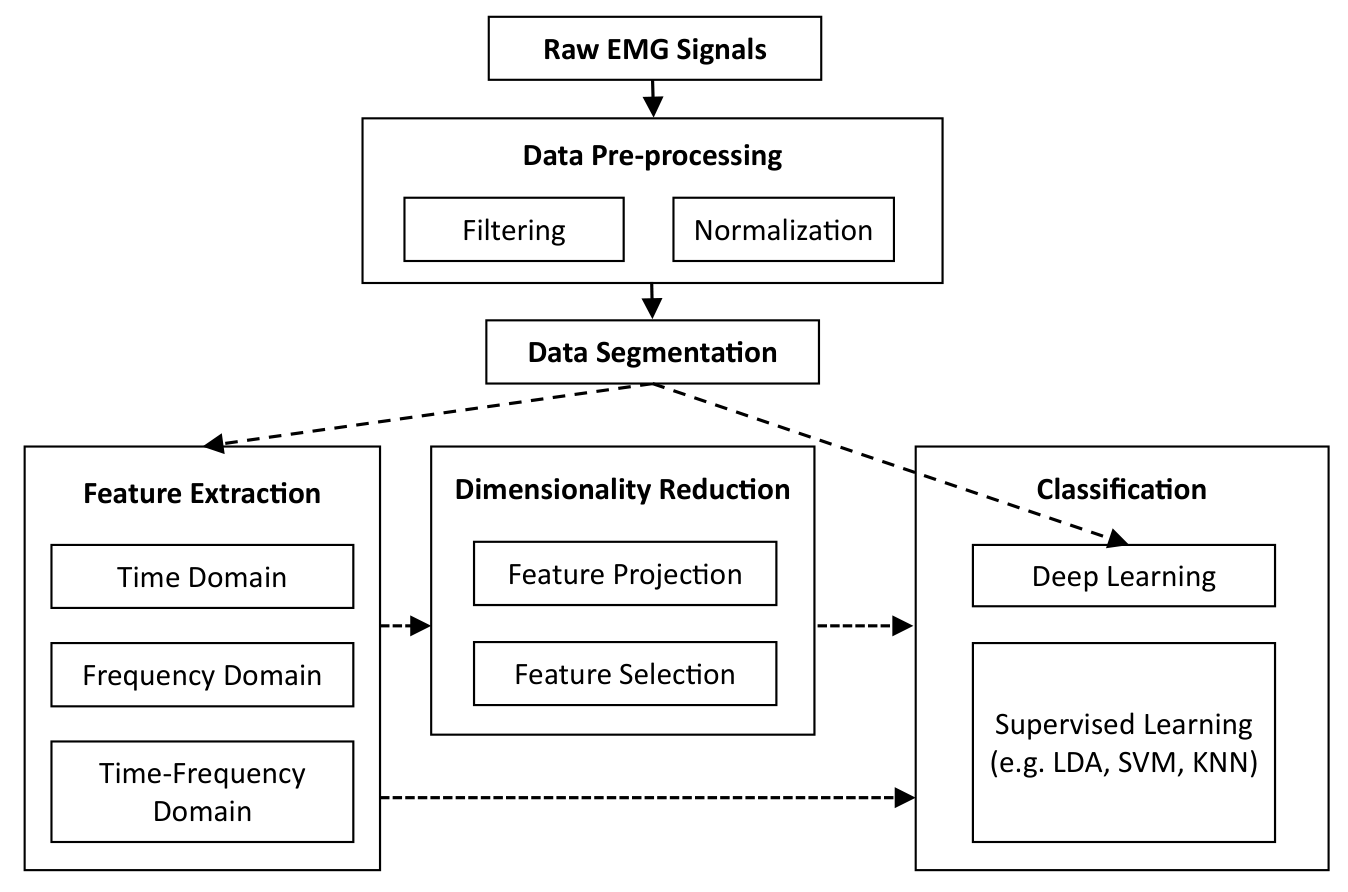
Read the solid downward path first: raw signals are prepared and divided into segments. The lower boxes then show several ways to construct a classifier. A conventional route extracts features and may reduce their dimensionality before classification. Another route supplies segmented input to a deep-learning model.
The arrows describe possible processing paths, not an experimental ranking. The diagram does not establish that one path is always best. Its value is to show where a design decision lives. Filtering changes the input; feature selection changes what information reaches the decision rule; classification changes how that information becomes an output.
The surrounding discussion supplies what a flowchart cannot: every stage is affected by the conditions under which the data were collected. A more elaborate path does not, by itself, provide evidence that the system will tolerate a new day or user.
What the results do not establish
This is a review of the literature available at the time, not a contemporary leaderboard. Performance numbers reproduced in the chapter belong to different source studies, with different tasks and experimental designs. They should not be assembled into a ranking as though they came from one common benchmark.
Nor is it a quantitative meta-analysis estimating one universal effect of force, noise, or position. The chapter identifies patterns and gaps while also describing disagreement between studies. A useful reading preserves that heterogeneity instead of turning each factor into a fixed expected accuracy penalty.
The treatment of practical robustness also remains incomplete by design. Studying one changing condition at a time helps explain it, but daily use combines conditions. The conclusion explicitly calls for investigating combined effects rather than assuming that individually successful remedies will automatically work together.
Looking back
A retrospective use for the chapter is as an experiment-design checklist. Before selecting a model, state what will change between calibration and use. Then ask whether the training set, the held-out data, and the outcome measure actually cover those changes.
A useful follow-up study would compare a small set of processing pipelines under a shared protocol, varying one factor at a time and then selected combinations. Reporting calibration time and online task performance alongside recognition metrics would make the cost of collecting more representative data visible, rather than treating it as a free improvement.
Those are retrospective suggestions. The chapter’s lasting contribution is the connection between processing choices and intended conditions of use: the experiment must represent the problem the interface is supposed to solve.
Read further
Phinyomark, A., Campbell, E., and Scheme, E. Surface Electromyography (EMG) Signal Processing, Classification, and Practical Considerations. In G. Naik (ed.), Biomedical Signal Processing, pp. 3–29. First published online in 2019; 2020 book edition. DOI: 10.1007/978-981-13-9097-5_1.
Open the original chapter on Springer Nature Link. Section 2 explains the pipeline, Section 3 reviews practical factors, Sections 4–5 cover hands-busy and cross-user settings, and Section 6 identifies unresolved questions. Full chapter access depends on the publisher’s access options.