How should movement of an input device translate into movement of the cursor? TFTune treats this transfer function as something that can be learned for a person through a short pointing task.
We used reinforcement learning to adjust gain and evaluated the resulting functions in three settings. The focus was the input-to-cursor mapping—creating or personalizing it—rather than improving the recognition of gestures or inferring a target on the user’s behalf.
The question
A transfer function controls how much cursor movement follows a given input. Operating-system defaults must serve many users and devices, while a person’s preferred balance between travel speed and fine correction can differ.
The study asked whether reinforcement learning could create a useful function from a simple starting point, improve an existing personal setup, and extend to the different input scale of muscle-controlled pointing.
The study at a glance
- Study one
- Twelve participants using a MacBook trackpad; TFTune compared with macOS and a reimplementation of AutoGain.
- Study two
- Fourteen participants using their own Windows mouse and monitor setups, followed by an at-home questionnaire.
- Study three
- Ten experienced EMG-interface users controlling a one-dimensional cursor.
- Learned quantity
- Gain as a function of input magnitude; trained policies could be converted into lookup tables.
How we approached it
The learning agent observed input magnitude and selected a gain that scaled the cursor movement. Reward combined progress toward the target with an outcome related to task throughput. Proximal policy optimization updated the policy through repeated interaction.
After tuning, the function was evaluated separately. It could run as a small network or be sampled into a lookup table, so using the learned mapping did not require continued exploration. The Windows study tested both a full-resolution table and a reduced five-point representation applied through the operating system.
Technical detail: the evaluation
Target information supplied the reward during tuning, but it was not an input required by the final transfer function. The deployed mapping takes device input magnitude and returns gain.
Movement-time analyses excluded trials with errors in the conventional pointing studies, so error rates and effective throughput must also be considered. The Windows baseline was always measured first; the two tuned conditions were counterbalanced afterward.
What we found
In the trackpad study, TFTune produced a mean movement time of 1.05 seconds, compared with 1.13 seconds for macOS and 1.10 seconds for AutoGain. Tuning averaged seven minutes for TFTune and thirteen for AutoGain. No significant condition effect on error rate was found.
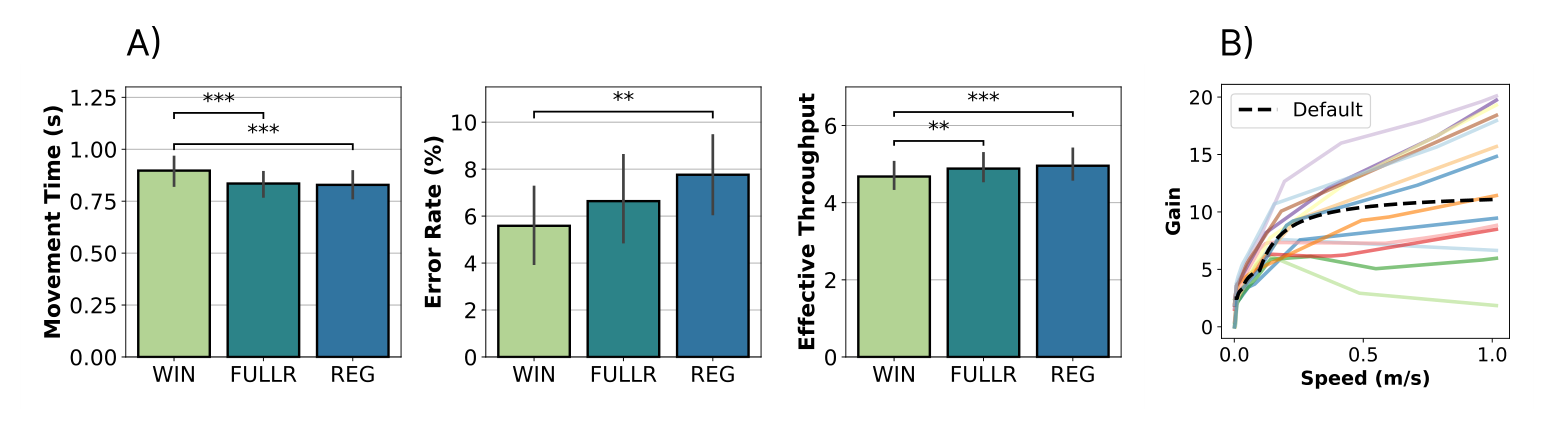
On participants’ Windows setups, tuning averaged 1.4 minutes. Both tuned representations achieved 0.83 seconds mean movement time versus 0.90 seconds for the existing function. However, the registry representation increased error rate from 5.6% to 7.8%, a significant difference. Effective throughput still improved, so the paper reports both sides of that tradeoff.
The EMG study changed the contraction-intensity-to-speed mapping while retaining the gesture recognizer. Mean movement time fell from 2.5 to 2.1 seconds after an average 2.4 minutes of tuning. This 16% reduction concerns the tested one-dimensional task and experienced users.
Eleven Windows participants responded after two to four weeks of home use; ten wanted to keep the personalized function and one was indifferent. Those reports concern perceived experience, not an objective longitudinal measurement of pointing speed.
Reading the figures
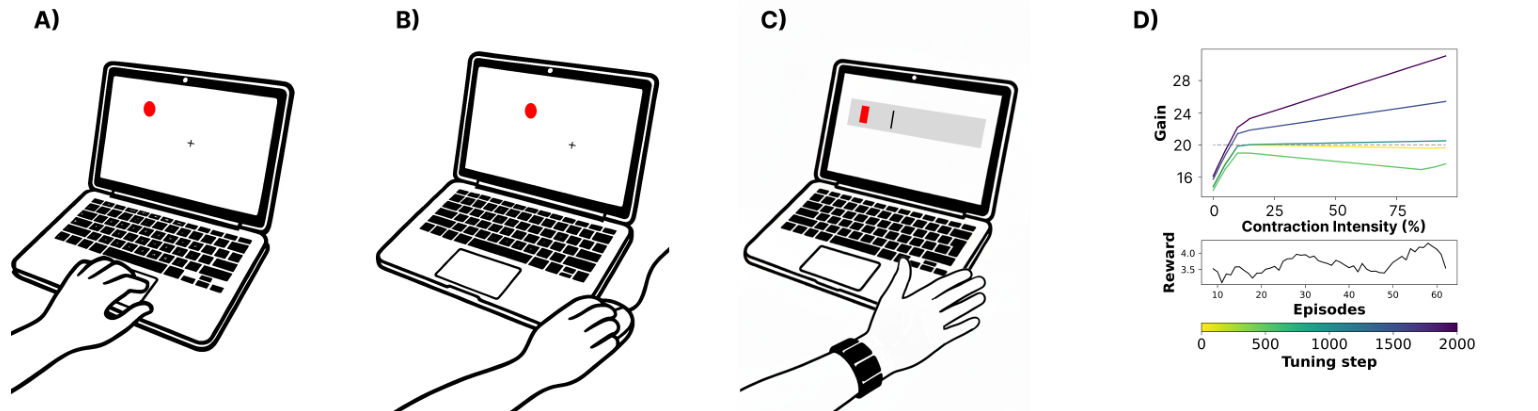
The first three panels identify the inputs being mapped to cursor movement. The final panel illustrates a function changing through learning and the corresponding reward trajectory.
The changing curve is a personalized mapping, not a learned target selector. After tuning, its gain can be evaluated directly for an input magnitude without knowing what the user is trying to click.
The Windows experiment places movement time, error rate, and effective throughput beside the learned transfer functions. This makes the speed–error trade-off visible: faster movement did not mean fewer errors in every deployment condition. The gain curves also show that participants did not all receive the same tuned function.
What the results do not establish
The studies involve modest university samples and specific pointing tasks. The EMG group already had relevant experience, and the results do not establish the same gains for novices or more complex control.
The Windows baseline order and reduced-resolution registry representation introduce distinct interpretation issues. The home questionnaire is encouraging but cannot establish long-term objective superiority. The reward also favoured throughput and could be revised for applications that place a higher cost on errors.
Looking back
The paper’s specific contribution is an experimentally evaluated way to tune the transfer function itself. Its three studies distinguish creation from personalization and show how deployment constraints can alter the speed–accuracy outcome.
A focused continuation would vary the error penalty and compare the resulting mappings under independent tasks. Longer objective follow-up could then test retention, adaptation to the new function, and whether benefits survive changes in device or display.
Read further
Ethan Eddy, Evan Campbell, Erik J Scheme, Scott Bateman, and Géry Casiez. TFTune: Creation and Personalization of Pointing Transfer Functions Using Reinforcement Learning. ACM CHI 2026, April 13–17, 2026. DOI: 10.1145/3772318.3790291.
Section 3 defines the learning problem and function extraction. Sections 4–6 report the three studies; the Windows results and at-home follow-up should be read separately.