How much gesture-training data must a new person provide if a model has already learned from other users? This paper evaluated cross-user recognition with only one calibration repetition of each gesture.
We extended ADANN to separate the work done in advance on other participants from the adaptation required when a new participant arrives. The focus was reducing that person’s training burden while maintaining useful gesture recognition.
The question
Training a model entirely on one person normally requires several repetitions of every gesture. A cross-user model can potentially reuse information from other people, but their muscle patterns do not automatically align with the new person’s recordings.
The study asked whether domain-adversarial training and a limited adaptation procedure could bridge that difference. It also compared the approach with simply training a personal model on the same small amount of new-user data.
The study at a glance
- Participants
- Ten intact-limbed participants and five participants with limb loss, analysed as separate populations.
- Task
- Seven classes, including no movement, from recordings containing sixteen trials.
- Signals
- Ten EMG channels at 1,000 Hz; 151 ms windows advanced every 50 ms.
- New-user data
- One repetition of each gesture for adaptation; other participants supplied pretraining data.
How we approached it
We compared conventional within-user training, within-user training from a single repetition, and cross-user training. Cross-user alternatives included an ordinary convolutional neural network and canonical correlation analysis (CCA), which projects paired recordings into a more similar feature space.
ADANN encouraged shared gesture-discriminating weights during pretraining while discouraging participant-specific information. Adaptation to the target participant then updated batch-normalization statistics. Keeping the main network weights fixed limited the risk of fitting a large model to a very small calibration set.
Technical detail: the evaluation
The target participant was excluded from cross-user pretraining but still supplied the adaptation repetition. This is limited-calibration transfer, not zero-shot recognition.
CCA required paired sequences with corresponding gesture progression. The study averaged results over possible expert users rather than assuming the best expert could be chosen in advance. A supplementary analysis also examined an intact-limbed expert for the limb-loss population.
What we found
ADANN achieved 96.2% mean recognition accuracy in the intact-limbed group and 84.2% in the limb-loss group. It significantly outperformed the tested CCA and conventional cross-user neural-network approaches. Keeping the populations separate is important: a single combined accuracy would obscure their different results.
The adaptation computation took approximately 47 seconds on the study’s hardware. Longer pretraining could be performed before the new person arrived. This timing concerns the adaptation calculation, not the total time to fit a device, collect calibration gestures, and begin using it.
Reducing the intact-limbed pretraining pool from ten to five participants reduced ADANN accuracy from 96.2% to 92.1%. This supplementary result suggests that unequal pool sizes contributed to the population comparison, alongside electrode-placement differences and inter-subject variability.
Reading the figures
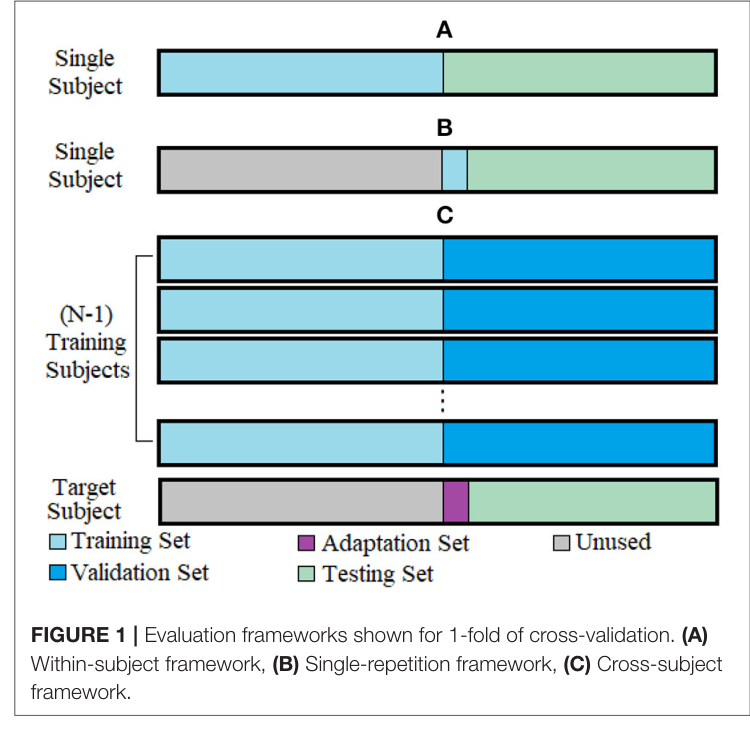
The coloured bars show where each kind of data enters the analysis. The cross-user panel separates the other participants from the target participant, whose small adaptation segment remains distinct from testing.
That small segment is central to the claim. The paper reduces the new person’s contribution; it does not remove it. Comparing this panel with the single-repetition panel shows why the same calibration effort can support different training strategies.
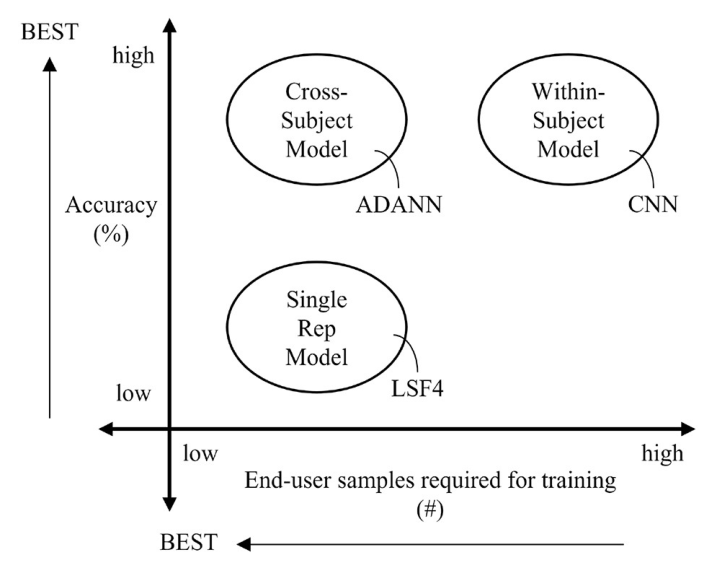
The paper’s concluding schematic places the evaluated approaches on two axes: recognition accuracy and the amount of end-user training data. It explains the intended trade-off behind cross-user adaptation. The positions are a qualitative summary, not a new numerical result or evidence of calibration-free control.
What the results do not establish
The analysis used recorded gestures under controlled conditions, with position, intensity, and transitions limited. It did not demonstrate the same performance during interactive use or after electrode shifts.
The limb-loss group contained only five participants. Its lower accuracy cannot be attributed to anatomy alone because pool size and electrode placement also differed. The reported adaptation time is hardware-dependent and does not directly measure user acceptance.
Looking back
The specific contribution is a workable division between shared pretraining and small new-user adaptation. Its value is assessed against models receiving comparable amounts of data from that new user, rather than against an undefined notion of effortless control.
A focused next study would compare calibration time and online task performance using the same one-repetition budget, then repeat the comparison across positions or sessions. That would test whether the reduced acquisition burden survives the conditions excluded here.
Read further
Evan Campbell, Angkoon Phinyomark, and Erik Scheme. Deep Cross-User Models Reduce the Training Burden in Myoelectric Control. Frontiers in Neuroscience 15, 657958, May 24, 2021. DOI: 10.3389/fnins.2021.657958.
Figure 1 defines the data partitions. Figures 2–4 compare recognition frameworks and summarize the results; the discussion explains the population and expert-user analyses.