A recognizer can classify a prompted gesture correctly and still trigger commands while someone types or writes. This paper addresses that second problem by teaching a model to distinguish target gestures from examples of daily activity.
We compared conventional rejection with two contrastive-learning approaches. The focus was the separation between intentional gesture classes and out-of-set activity, while checking that better rejection did not sacrifice the original recognition task.
The question
A closed-set model must choose among the classes it knows. An unfamiliar action can therefore receive a confident but inappropriate gesture label. A threshold on confidence helps only if unfamiliar activity actually receives lower confidence.
The study asked whether the representation itself could be trained to separate commands from daily activity. It also tested whether grouping daily-activity examples together improved rejection beyond simply pushing them away from target gestures.
The study at a glance
- Participants
- Twenty-two people, aged 20–31, using an eight-channel Myo Armband.
- Commands
- Six dynamic gestures; ten repetitions per class.
- Daily activity
- Walking, typing, writing, simulator driving, and phone use, recorded for two minutes each.
- Comparisons
- Softmax probability rejection, embedding-distance rejection, and two triplet-loss approaches.
How we approached it
An LSTM network encoded the temporal pattern of each one-second EMG template using sequences of root-mean-square features. Conventional training optimized gesture-class prediction. The contrastive alternatives additionally learned from selected activity examples.
Triplets contained an anchor, a similar positive example, and a dissimilar negative example. One strategy drew negative examples from other gestures or daily activity. The grouped variant also encouraged activity examples to be close to one another, creating a more distinct region outside the target-gesture clusters.
Technical detail: the evaluation
Each participant’s prompted gestures were split into eight training and two testing repetitions per class. One hundred templates were sampled from the activity recordings for contrastive training.
Rejection was evaluated over extracted activity templates and summarized with receiver-operating curves and their area, AUC. This is not a count of false commands per hour, and the study does not constitute a held-out-activity-category test or calibration-free cross-user evaluation.
What we found
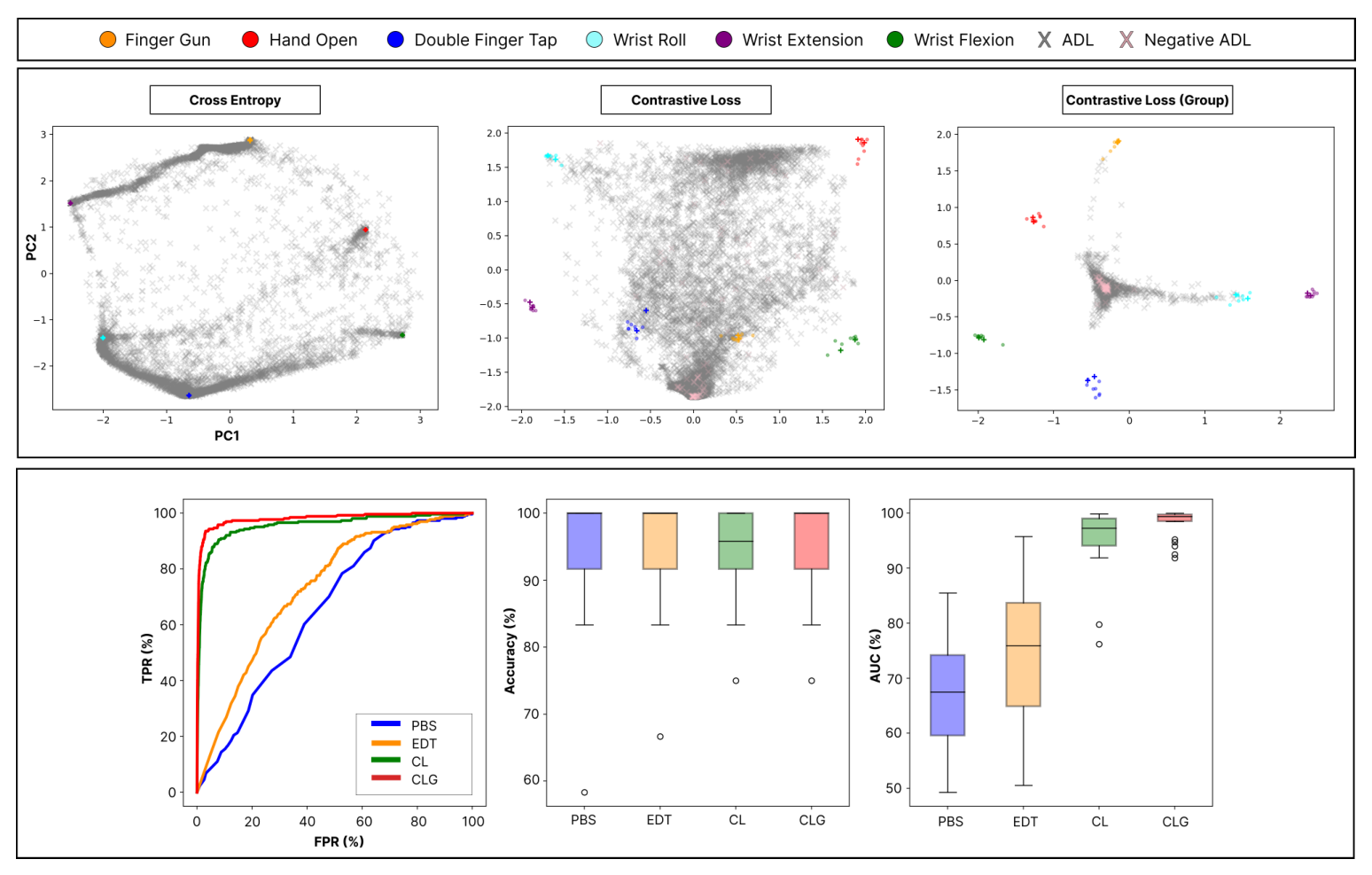
Mean AUC was 67.2% for softmax probability rejection and 73.4% for distance rejection after conventional training. It rose to 95.3% with contrastive learning and 98.2% with the grouped contrastive variant.
Closed-set accuracies remained close: 94.7%, 94.7%, 94.3%, and 94.7%, respectively. No significant accuracy differences were found, while both contrastive approaches significantly improved AUC. The evidence therefore concerns better separation from activity while maintaining the trained gesture task.
The high AUC of the grouped variant is encouraging, but it does not mean that a deployed threshold will accept every command and reject every activity. AUC summarizes a family of thresholds; a specific operating point still determines the actual tradeoff.
Reading the figures
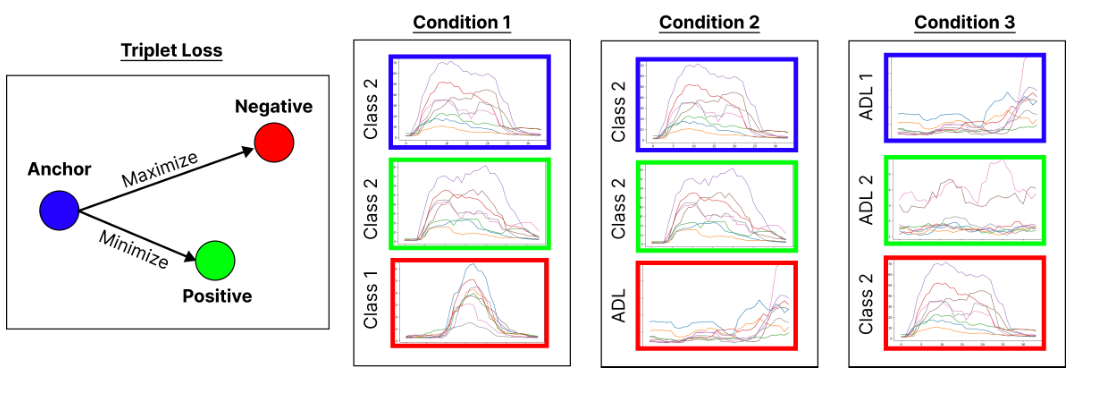
The anchor is drawn toward the positive example and away from the negative example. The three conditions change what those examples represent: another target class, daily activity as a negative, or daily activity grouped with other activity.
The illustration explains what training encourages in the learned representation. The reported receiver-operating curves are needed to determine how well that structure separates the evaluated inputs.
The upper plots illustrate how the training objectives arrange gestures and daily activity for one participant. The lower plots provide the detection and classification comparisons. Their combination explains the paper’s focus: improved separation from daily activity can be substantial even when gesture-classification accuracy is similar. The projection alone is not the performance metric.
What the results do not establish
The method requires negative activity examples. The experiment used a small sample of each participant’s activity pool, so it does not establish the same benefit without collecting such data from the target user.
Activity templates overlap in time, and the recorded activities cover only part of everyday behaviour. The results should not be described as eliminating false activations in arbitrary environments. Online command timing, missed events, and repeated detections remain separate evaluation questions.
Looking back
The paper’s focus is the benefit of explicitly shaping the command-versus-activity boundary. Comparing the two conventional rejection methods with contrastive training helps separate changing a threshold from changing the information that the threshold operates on.
A focused continuation would hold out entire activity types and recording sessions, then measure false commands per unit time at a fixed true-command acceptance rate. It would also test whether other users’ activity examples can replace the target user’s negative-data collection.
Read further
Ethan Eddy, Evan Campbell, Scott Bateman, and Erik Scheme. Human-Machine Interaction Using Discrete Myoelectric Control: Contrastive Learning Reduces False Activations During Activities of Daily Living. IEEE BioRob, pp. 128–133, September 2024. DOI: 10.1109/BIOROB60516.2024.10719934.
Sections II-C–D define the triplet conditions and rejection metrics. Figures 4–5 report the representation, receiver-operating curves, AUC, and closed-set accuracy.