What if rotating an EMG armband could be represented as shifting the columns of an image? This paper designs the sensor geometry and learning method together so that this correspondence becomes useful.
We introduced EMaGer, a flexible 64-channel high-density EMG armband, and array barrel-shifting data augmentation (ABSDA). The study evaluated whether exposing a recognizer to those synthetic shifts improved recognition after physical cuff rotation or between recording sessions.
The question
Removing and replacing an armband changes which muscle regions lie beneath its electrodes. A classifier trained at the original placement can therefore encounter a different spatial pattern even when the person performs the same gesture.
The study asked whether a full-circumference array with consistent spacing could make that displacement predictable enough to simulate during training. Sensor rotation, forearm rotation, and between-session replacement were tested separately because they need not create the same signal changes.
The study at a glance
- Sensor
- A stretchable 4 × 16 electrode array, sampled at 1,000 Hz with 16-bit resolution.
- Participants
- Twelve non-amputated participants for the two-session dataset; three participants for each dedicated rotation experiment.
- Gesture task
- Six classes, including rest, with matched subsets from CapgMyo and Hyser for comparison.
- Models
- Convolutional and anti-aliased convolutional networks, with and without circular-shift augmentation.
How we approached it
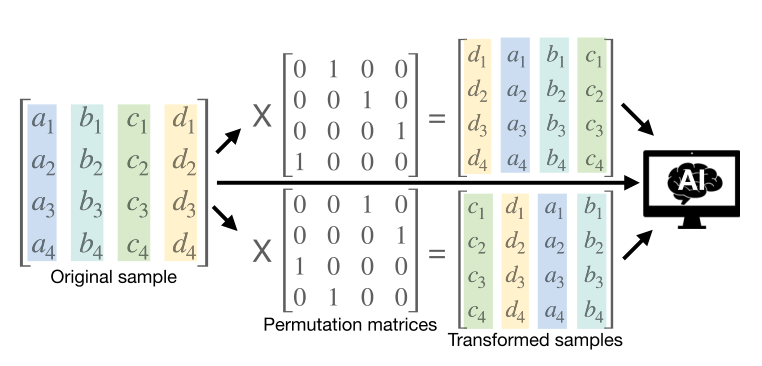
The electrode array spans the circumference of the forearm. A circular shift moves its data columns while wrapping the displaced columns around to the opposite side. This preserves the cylindrical relationship instead of introducing an artificial empty edge.
ABSDA presents several such shifts during model training. The study also tested anti-aliasing within the network, intended to reduce sensitivity to location changes introduced by subsampling. The resulting models were evaluated on actual recordings after cuff rotation and replacement, not solely on synthetically shifted test arrays.
Technical detail: the evaluation
The inter-session analysis trained on one session and tested on the other, in both directions. Within-session analyses held out gesture repetitions. The dedicated sensor-rotation recordings covered −45° to +45°, with intermediate increments of approximately 11.3°.
The comparison reports results with short and 150 ms majority-voting windows. Voting affects the decision stream and response characteristics, so results should be compared under matching voting conditions.
What we found
For EMaGer, ABSDA increased inter-session accuracy by 25.67 percentage points in the CNN comparison with 150 ms majority voting. This is the difference between the corresponding conditions in Table VI, not an improvement averaged over every sensor and experiment.
The same augmentation was not beneficial for every array. With CapgMyo, the corresponding comparison decreased accuracy by 13.01 percentage points. Its uneven spacing around the limb makes a uniform circular data shift a less faithful representation of physical rotation.
Physical sensor-rotation tests showed benefits from augmentation and, in relevant conditions, anti-aliasing. Forearm pronation and supination did not show the same clear improvement. Longitudinal movement along the arm was not addressed by the circular-shift method.
Reading the figures
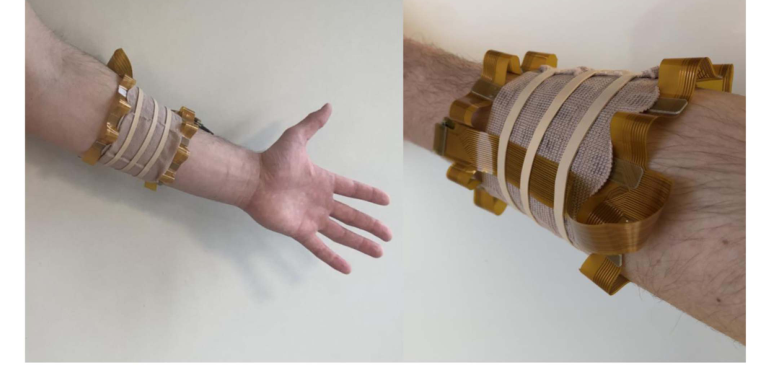
The close view shows how the array wraps around the forearm and stretches to fit it. That layout matters to the learning method: neighbouring columns represent successive positions around a continuous circumference.
The photograph explains the physical premise of barrel shifting. It does not itself demonstrate shift tolerance; that evidence comes from the held-out-session and rotation experiments.
The augmentation diagram shows why the cylindrical electrode layout matters. Moving columns and wrapping them around the array simulates shifts around the circumference without introducing an artificial edge. It describes the array barrel-shifting method; it does not model every effect of moving an electrode or rotating the forearm.
What the results do not establish
The dedicated rotation experiments involved three participants each. Their angular range is useful evidence about the tested cuff, but does not establish reliable recognition for arbitrary repositioning or all users.
Comparisons with other public datasets also differ in participants and acquisition conditions. They support the importance of matching augmentation to geometry, but are not a controlled comparison in which only the hardware changes. The study evaluated gesture classification, not continuous proportional regression.
Looking back
The contribution is specific to a correspondence between physical displacement and the array representation. Circular augmentation helps when it approximates a change the sensor actually experiences; the negative CapgMyo result is part of that finding.
A focused extension would measure longitudinal shifts and combined radial-longitudinal displacement, then test whether a physically justified augmentation can address them. A larger rotation cohort would also clarify how consistent the observed gains are across forearm anatomy and fit.
Read further
Félix Chamberland, Étienne Buteau, Simon Tam, Evan Campbell, Ali Mortazavi, Erik Scheme, Paul Fortier, Mounir Boukadoum, Alexandre Campeau-Lecours, and Benoit Gosselin. Novel Wearable HD-EMG Sensor With Shift-Robust Gesture Recognition Using Deep Learning. IEEE Transactions on Biomedical Circuits and Systems 17(5), pp. 968–984, September 11, 2023. DOI: 10.1109/TBCAS.2023.3314053.
Table VI separates session, augmentation, voting, and anti-aliasing conditions. Figures 14–17 distinguish cuff rotation from forearm rotation. Chamberland, Buteau, and Tam contributed equally.