How does changing skin temperature affect the EMG used for gesture recognition? This paper examines signal properties and classifier performance after controlled cooling and warming.
We recorded five hand/wrist classes under baseline, cold, and hot conditions, then compared EMG feature sets, sensor combinations, and training-temperature coverage. The focus was the measured effect of temperature and whether representative training could reduce it.
The question
Temperature can affect the skin–electrode interface and physiological processes underlying the recorded signal. Those mechanisms make temperature a plausible source of variation, but measuring a changed signal does not establish which mechanism caused it.
The study therefore asked two operational questions: which measured EMG properties change, and how does a classifier trained at baseline perform on the other conditions? It then tested whether including temperature-diverse examples helps under a matched training-data budget.
The study at a glance
- Participants
- Twelve people without limb differences.
- Conditions
- Baseline, cooling toward 17°C, and warming toward 37°C, with comfort limits and measured skin temperatures.
- Task and sensors
- Five gesture classes; BioPoint EMG, PPG, and IMU recordings at one forearm site.
- Analyses
- Signal amplitude, median frequency, fuzzy entropy, LDA recognition, modality fusion, and temperature-diverse training.
How we approached it
Participants completed the three conditions in randomized order. Their forearms were cooled or warmed with water, then dried before recording. Device placement was marked, and skin temperature was measured before and after each session using a separate thermometer.
Signal-property analysis used the closed-hand gesture. Recognition analyses used the isometric portions of seven five-second repetitions of each class. Four EMG feature sets were compared, followed by combinations with optical and inertial measurements.
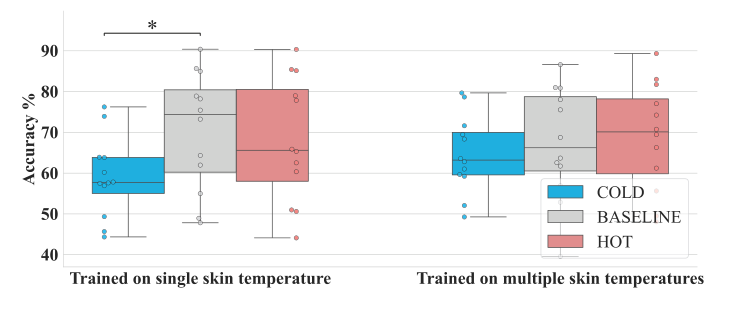
The final comparison kept the training quantity consistent while changing whether examples came only from baseline or from all three thermal conditions. That isolates training diversity more clearly than simply giving one model more recordings.
Technical detail: the evaluation
The cold and hot values were target conditions, subject to comfort limits, rather than identical achieved temperatures for every person throughout acquisition. Figure 2 documents individual temperature variation and the data partitions.
Signal properties and recognition accuracy answer different questions. An unchanged entropy measure does not imply every aspect of the signal is unchanged, and a recognition change does not directly identify a physiological mechanism.
What we found
For the closed-hand recordings, mean absolute value rose from 0.018 mV at baseline to 0.023 mV in the cold condition. Median frequency fell from 96.1 Hz to 88.8 Hz. Both cold–baseline differences were significant. The corresponding hot-condition values were closer to baseline.
Fuzzy entropy did not differ significantly across conditions. This is evidence about the selected complexity measure, not proof that all nonlinear properties are temperature-invariant.
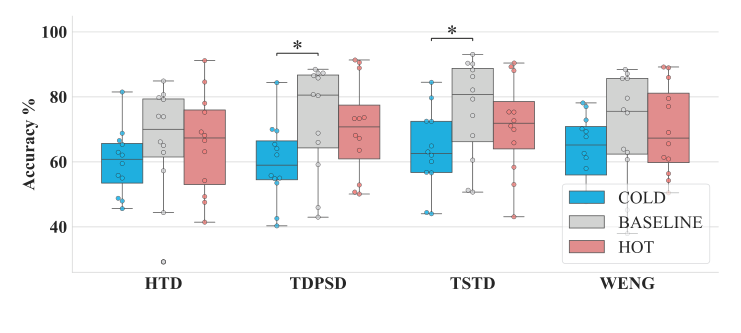
Cold conditions significantly reduced baseline-trained recognition for the TSTD and TDPSD feature sets, while not every feature-set comparison was significant. Wavelet energy was comparatively consistent in this experiment. Adding PPG and IMU improved baseline recognition but increased sensitivity to changed thermal conditions.
Temperature-diverse training improved cross-condition robustness at a cost to baseline performance. The result is a tradeoff in the tested operating range, rather than a temperature-compensation method that removes every loss.
Reading the figures
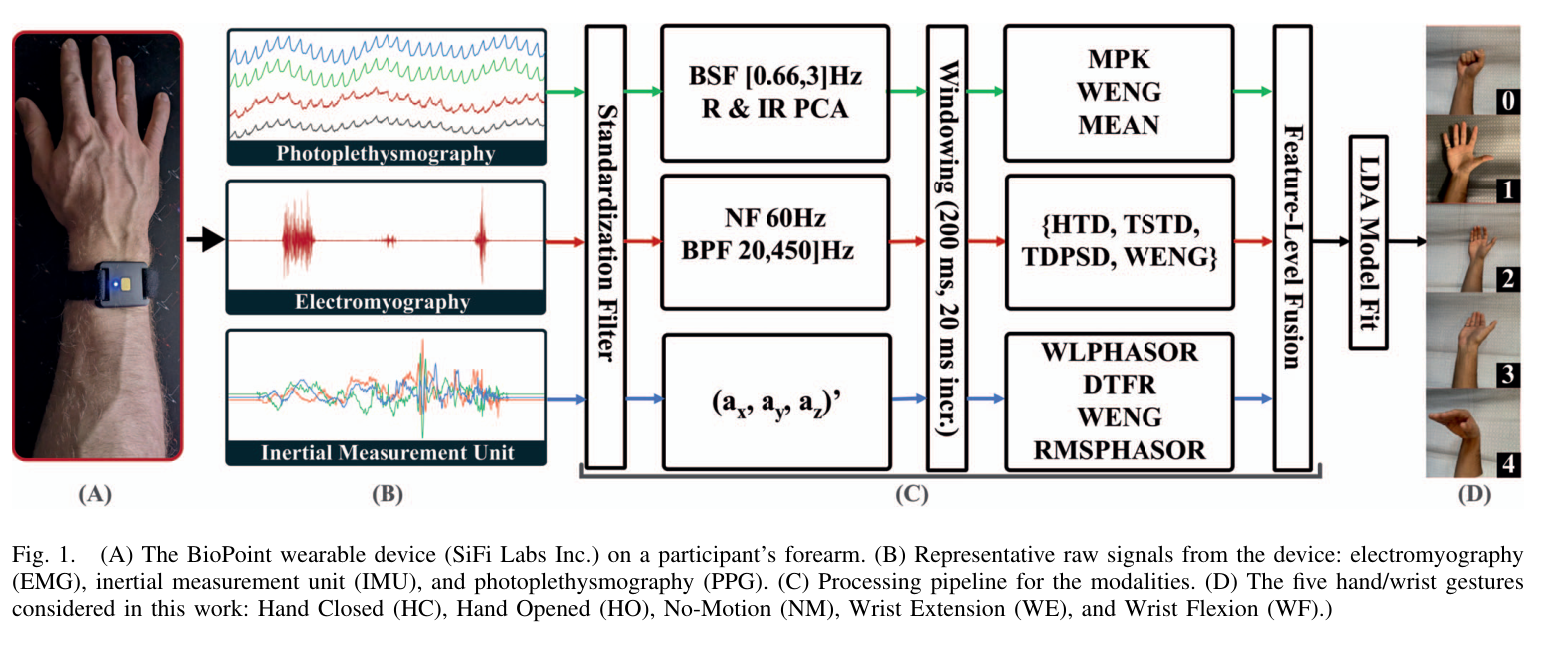
The branches show that EMG, optical, and inertial data receive different processing before feature-level fusion and LDA classification. The gesture images identify the recognition vocabulary.
The diagram explains the modality comparison; it does not depict the temperature manipulation itself. Figure 2 in the paper supplies the measured temperatures needed to interpret the thermal experiments.
The feature-set comparison shows why the temperature result needs condition-specific wording. Cold, baseline, and hot recordings are plotted separately, with the supported baseline-versus-cold differences marked for TDPSD and TSTD. The figure does not establish an equivalent significant effect for every feature set or both temperature directions.
The training-diversity comparison tests whether examples from different temperatures can help under a fixed training-data budget. Read the cold and baseline distributions together: improved thermal coverage can involve a trade-off in the baseline condition. The result concerns the sampled temperatures and protocol, not a guarantee of general temperature invariance.
What the results do not establish
Water exposure, skin contact, participant behaviour, and temperature-related physiology may all contribute to the observed changes. The experiment reduces some acquisition differences but does not separately measure every mechanism.
The study is offline, uses a single-site device, and includes no participants with limb loss. Its title’s “fifth” factor is an organizing description, not an exhaustive count of the possible influences on myoelectric control.
Looking back
The useful contribution is a measured temperature comparison that links signal properties to recognition under defined conditions. The different responses of feature sets and sensor combinations prevent the result from being reduced to a universal temperature penalty.
A focused follow-up would measure skin impedance and actual contraction force alongside temperature, then test gradual thermal changes during online use. That would help separate sensing changes from altered contraction behaviour and assess whether the training tradeoff remains worthwhile during control.
Read further
Etienne Michaud, Xavier Isabel, Evan Campbell, Raphaël Paradis, Dylan Renaud, Ulysse Côté-Allard, and Benoit Gosselin. The Fifth Main Dynamic Factor: Skin Temperature and Its Effects on EMG-Based Gesture Recognition. 47th IEEE EMBC, July 2025. DOI: 10.1109/EMBC58623.2025.11253012.
Table I reports signal properties. Figures 2–5 show measured temperatures, feature comparisons, modality combinations, and temperature-diverse training. Michaud and Isabel contributed equally.