When an EMG recognizer adapts from its own predictions, how can it tell which predictions are worth learning from? This pilot study tested whether progress toward a known cursor target provides better guidance than classifier confidence alone.
We compared updates that reinforced useful actions, corrected unhelpful actions, or combined both. The focus was the quality of the labels used for adaptation when the starting model had very little training data.
The question
An unsupervised adaptive classifier often treats confident predictions as provisional labels. If its decision boundary is wrong, however, confidence can reinforce the error.
In a target-acquisition task, the application knows something the classifier does not: where the cursor is supposed to go. Moving toward the target provides positive context; moving away provides negative context. The study asked whether that information could improve adaptation without another sensor or explicit gesture labels during play.
The study at a glance
- Study
- Eleven participants using an eight-channel Myo Armband.
- Initial calibration
- One second for each of five classes: four cursor directions and rest.
- Adaptation
- Two minutes of gameplay with LDA parameter updates every ten seconds.
- Comparisons
- No adaptation, unsupervised high confidence, negative context, positive context, and positive plus negative context.
How we approached it
Positive context retained predictions that moved toward the target or held the cursor still within it. Negative context relabelled predictions that moved away, or moved when the cursor should remain on target. When two directions were plausible, the negative strategy used feature-space proximity to choose between them.
The classifier used conventional time-domain EMG features. Context changed the examples used in periodic model updates; it did not override the immediate cursor command. After gameplay, the adapted model was assessed on recorded gesture trials and on a separate Fitts-style target-acquisition task.
Technical detail: the evaluation
Adaptation stopped during the online assessment, allowing the resulting models to be compared. Offline accuracy was measured on twelve recorded testing repetitions accumulated through the session.
One participant could not complete the online test with the initial model and was excluded from the online statistical comparison. All adaptation strategies subsequently enabled that participant to complete the task. Thus the online and offline analyses do not have identical sample sizes.
What we found
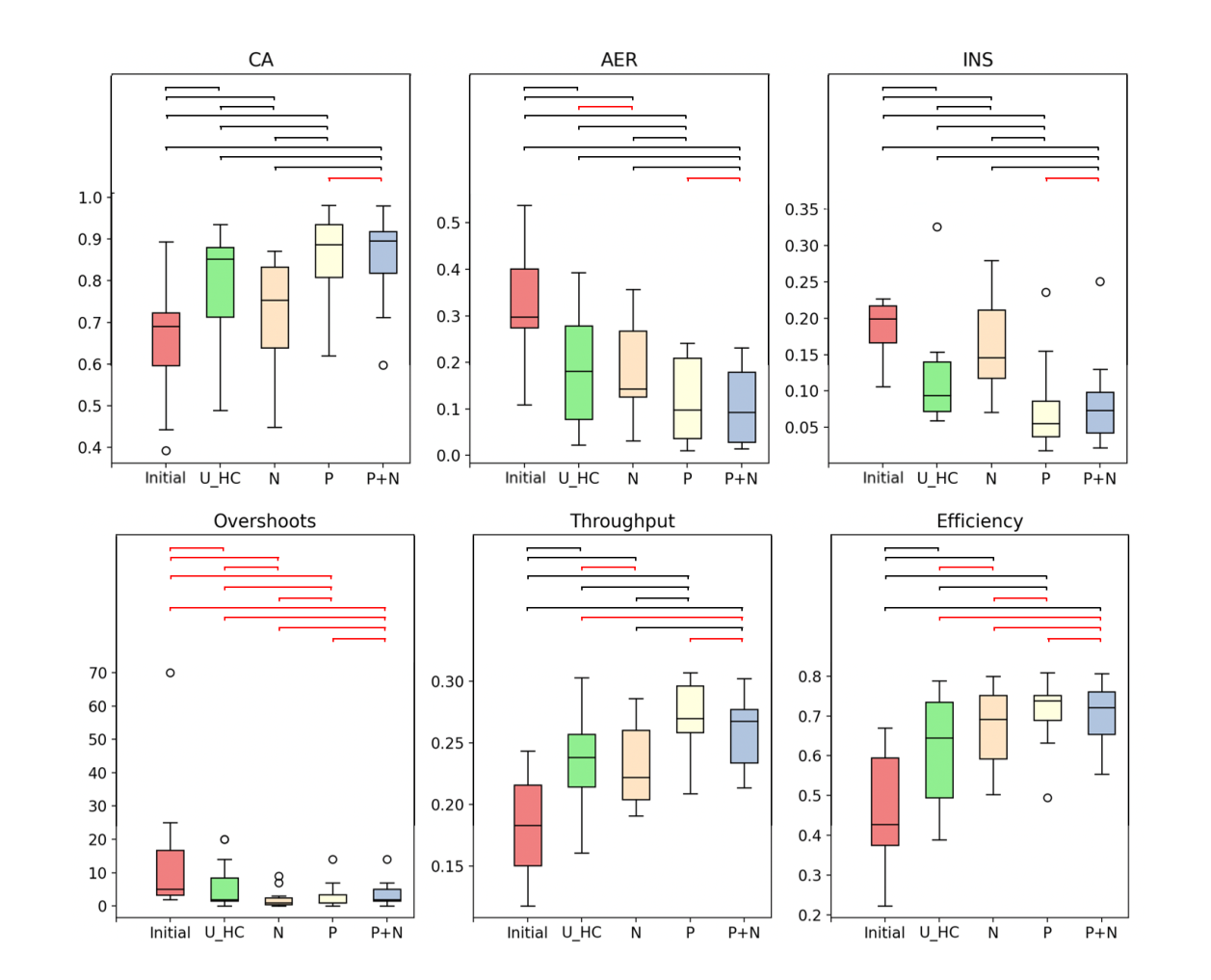
Offline accuracy was 65.7% for the initial model, 79.1% after high-confidence adaptation, 72.5% after negative context, 86.0% after positive context, and 85.2% after combined context. Positive and combined context significantly outperformed the other strategies on the reported offline measures.
Mean online throughput was 0.18 bits/s initially, 0.22 with high-confidence adaptation, 0.23 with negative context, 0.27 with positive context, and 0.26 with combined context. Positive context also improved throughput relative to high-confidence adaptation in the reported comparisons.
There was no significant difference between positive and combined context. These results therefore support the value of positive task evidence in this setup; they do not establish that adding negative relabelling always helps.
Reading the figures
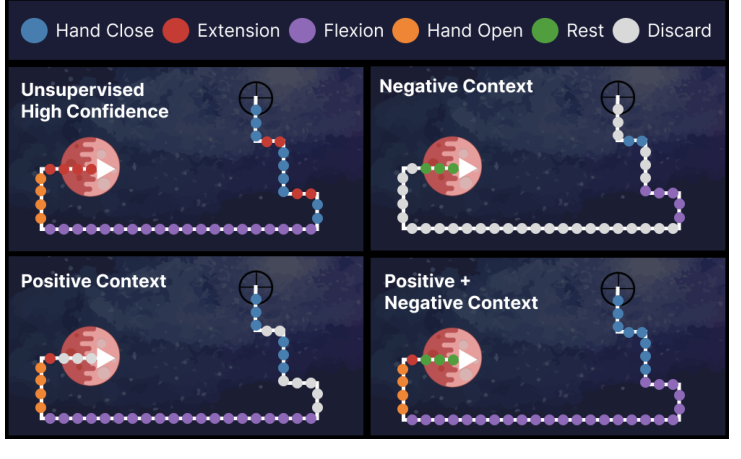
The cursor path is shown under different rules for assigning training labels. Colours identify gesture classes; white points indicate discarded examples. The same movement history can therefore produce different adaptation data.
This is a schematic explanation of the strategies, not four measured participant outcomes. It shows the source of their disagreement: confidence, successful movement, and corrected movement provide different evidence about an intended action.
This figure places the offline and online outcomes side by side. The top row concerns recorded-data predictions; the lower row concerns cursor-control behaviour. The statistical connectors matter because higher or lower medians do not imply that every adaptation strategy differed significantly from every other one.
What the results do not establish
A known target constrains what counts as useful movement, but it does not reveal the participant’s intent perfectly. Diagonal target directions create ambiguous corrections, and a user may deliberately make an apparently unhelpful movement.
The pilot started from sparse calibration rather than a deliberately displaced armband. It did not establish recovery after a catastrophic signal shift, and its small sample and short sessions do not establish long-term reliability.
Looking back
The result is about selecting adaptation evidence, particularly the benefit of reinforcing actions that accomplish the task. It should not be broadened into a claim that any available context automatically produces correct labels.
A focused continuation would test the same strategies after a controlled electrode shift, when the model may initially produce few successful actions. Another would vary target ambiguity to measure when negative relabelling becomes useful or harmful.
Read further
Ethan Eddy, Evan Campbell, Scott Bateman, and Erik Scheme. Leveraging Task-Specific Context to Improve Unsupervised Adaptation for Myoelectric Control. IEEE SMC, pp. 4661–4666, October 2023. DOI: 10.1109/SMC53992.2023.10394393.
Sections II-D–F define the strategies and assessments. Figure 3 reports offline and online outcomes, while Figure 4 visualizes the resulting feature-space decisions. Eddy and Campbell contributed equally.