Can inertial measurements recognize hand gestures better than muscle recordings? This study investigated why biomedical and human-computer interaction studies appeared to give different answers.
We compared publicly available recordings with different movement protocols. The focus was the information available under those protocols: whether the task required distinguishing hand gestures at controlled positions, or allowed gestures to have distinct arm-position patterns.
The question
An accelerometer measures acceleration, including the contribution of gravity. Its output can therefore change when the forearm changes orientation even if the hand gesture remains the same. EMG measures electrical muscle activity and responds differently to this change.
The study asked whether seemingly conflicting sensor rankings could be reproduced and understood by examining the definition of the recognition task. “Recognize the gesture” is incomplete unless the accompanying position and movement are also specified.
The study at a glance
- Biomedical dataset
- Twelve intact-limbed participants; six gestures plus no movement, repeated at five static positions.
- HCI dataset
- Twenty intact-limbed participants from NinaPro database 7; analyses of matched gestures, finger movements, and grasps.
- Modalities
- EMG and accelerometers; accelerometer signals low-pass filtered at 1 Hz.
- Evaluation
- Within-participant, held-out-trial recognition; position, gesture, and sequential position-then-gesture tasks.
How we approached it
We extracted standard time-domain and time-domain power spectral descriptors from EMG. Accelerometers were represented by median or root-mean-square values. Four classifiers provided comparisons, including linear discriminant analysis (LDA).
The biomedical recordings allowed position recognition to be measured directly, followed by gesture recognition within each position. They also supported a sequential recognizer: first identify position from acceleration, then use a position-specific EMG model. The HCI recordings did not specify position in the same way, so equivalent position-conditioned tests were unavailable.
Technical detail: the evaluation
Features came from 200 ms windows advanced every 100 ms. The 1 Hz accelerometer filtering emphasizes slow orientation information; these results do not compare every possible use of a complete inertial measurement unit, which can also include gyroscopes.
The matched HCI subset shared six gesture labels with the biomedical data. Matching labels narrows the comparison, but does not match the participants, sensors, or movement execution.
What we found
For the biomedical data, LDA classified position with 99.9% mean accuracy using median accelerometer features. That is position accuracy, not hand-gesture accuracy. Within position, conventional EMG time-domain features achieved 96.2% gesture accuracy, compared with 69.8% for accelerometer medians.
The ranking reversed in the matched HCI gesture subset: accelerometer medians achieved 97.1%, while the conventional EMG time-domain features achieved 89.1%. The examples show distinct acceleration profiles accompanying those gestures, unlike the relatively fixed profiles in the biomedical recordings.
The sequential biomedical recognizer achieved 96.0% using accelerometer-based position recognition followed by EMG-based gesture recognition. This provides a concrete example of complementary roles for the sensors within the tested static-position task.
Reading the figures
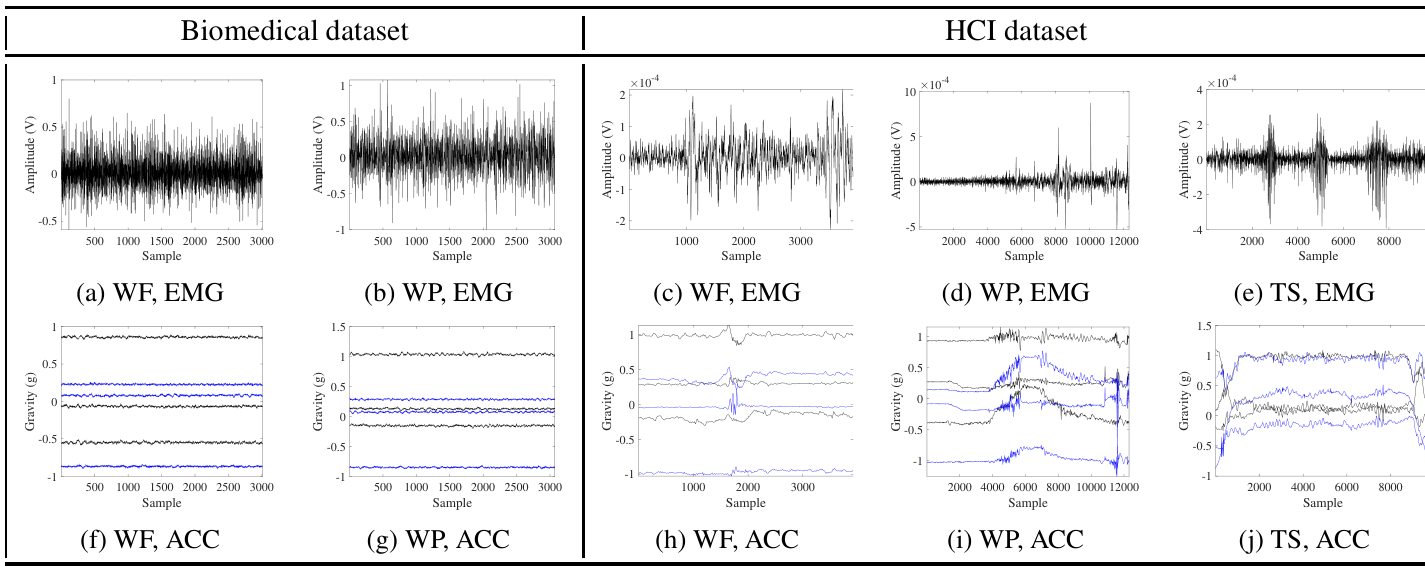
The upper row shows EMG and the lower row shows acceleration. Columns compare wrist flexion and pronation across datasets, with a turn-screw example also shown for HCI. The lower-row axes correspond to different acceleration directions.
Notice the fairly constant acceleration in the fixed-position examples and the changing profiles in the HCI examples. These traces illustrate an interpretation of the dataset-level results; they do not establish that every example in either research field behaves this way.
What the results do not establish
The study compared two existing datasets rather than experimentally changing position constraints in an otherwise identical collection. Position information is a plausible explanation supported by the traces and recognition results, but other protocol and hardware differences remain.
The findings do not show that accelerometers are unsuitable for biomedical control or that HCI gesture recognition is inherently position-dependent. They also leave open the contribution of faster transient inertial signals excluded by the selected filtering.
Looking back
The paper’s specific contribution is to reconcile sensor rankings through a closer description of the task being measured. A claim about gesture information should say whether the recognizer must remain accurate across positions or may use a position associated with a gesture.
A direct follow-up would collect the same gestures with and without controlled positions, using identical hardware and participants. Adding transient-sensitive accelerometer features would separately test what was lost by concentrating on slow orientation information.
Read further
Evan Campbell, Angkoon Phinyomark, and Erik Scheme. Differences in Perspective on Inertial Measurement Unit Sensor Integration in Myoelectric Control. MEC20 manuscript on arXiv, March 6, 2020. DOI: 10.48550/arXiv.2003.03424.
Tables 1–4 separate position accuracy, within-position gesture accuracy, and sequential recognition. Figure 1 shows the signal examples behind the interpretation.