How can a myoelectric controller learn from the contractions a person produces while actually using it? This short MEC paper presents context-informed incremental learning as a way to label those interactions without repeating a separate calibration routine.
The report draws on the same sparse-training and electrode-shift experiments described in the related journal article. It emphasizes the use of goal-directed feedback to incorporate user-in-the-loop behaviour, rather than presenting an independent replication of those results.
The question
Screen-guided training asks for prescribed contractions without requiring the person to correct an ongoing action. Interactive control adds feedback, speed modulation, and corrective behaviour. Those recordings need not occupy the same regions of feature space.
The study asked whether contextual information could make those online examples useful for learning. Its comparison with high-confidence adaptation also tests whether the classifier’s own certainty is sufficient when the initial mapping has become poor.
The study at a glance
- Hardware
- Eight-channel Myo Armband at 200 Hz, processed using LibEMG.
- Controller
- Adaptive LDA over five gesture classes, mapped to four cursor directions and rest.
- Short-calibration scenario
- Eleven participants, one second per class initially, then two minutes of adaptive gameplay.
- Shift scenario
- Twenty-one participants, conventional calibration, a 45° cuff rotation, then five minutes of adaptive gameplay.
How we approached it
Context described whether a cursor action agreed with movement toward the current target. Suitable actions were retained as training examples. Unsuitable actions could be relabelled using the available contextually plausible alternatives.
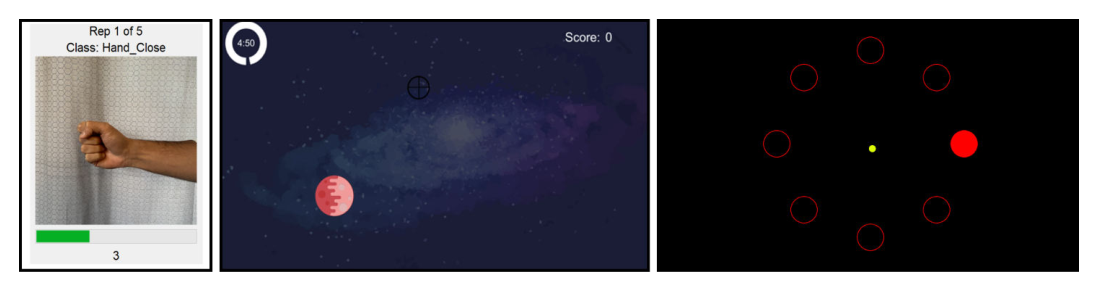
The classifier updated in ten-second batches during the game. A subsequent Fitts-style task evaluated control using the adapted model with adaptation disabled. Recorded gesture trials provided a separate offline assessment.
Technical detail: the evaluation
The first scenario used constant cursor velocity; the second used proportional control. Their throughputs therefore should not be compared as a pure measure of electrode-shift severity.
The conference paper points to the journal report for further experimental details. Its results belong to that shared evidence base, even though the shorter presentation places more emphasis on training with the user in the loop.
What we found
With only one second of initial data per class, contextual adaptation reached online performance comparable to the full screen-guided-training model after two minutes. High-confidence adaptation also helped in this relatively favourable starting condition, although it performed less well than CIIL on throughput.
In the shift scenario, offline accuracy fell from 87.8% before displacement to 48.3% afterward, demonstrating a substantial change in the mapping. Context-informed adaptation subsequently recovered control, while high-confidence adaptation was much less successful.
After five minutes, CIIL significantly outperformed the pre-shift screen-guided model on the reported online comparison. This result concerns task performance after interacting and adapting; it does not mean that every original gesture label was recognized more accurately on the prompted recordings.
Reading the figures
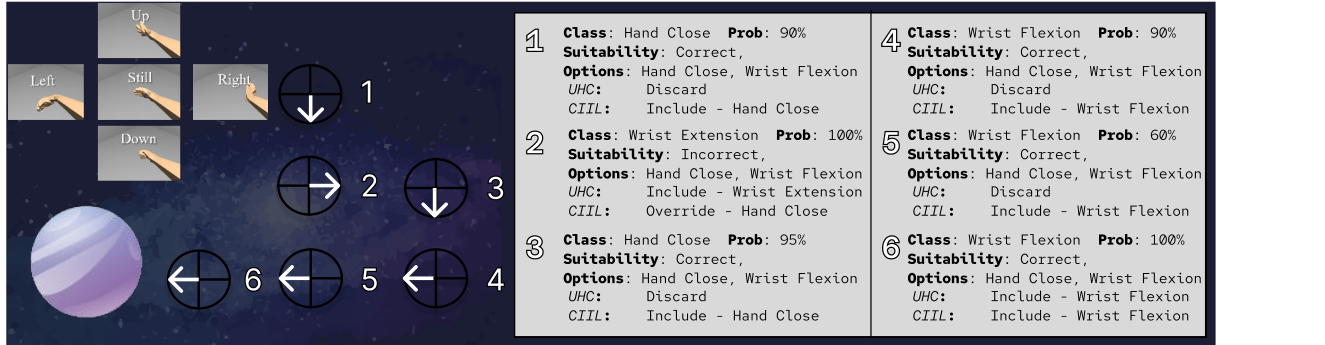
The table follows numbered actions along the cursor path. High-confidence adaptation considers whether the model is certain; CIIL also considers whether the action fits the target direction.
Rows with several plausible directions show that context may supply a set of possibilities rather than a perfectly known gesture. This ambiguity is part of the learning problem, not something removed by calling the information contextual.
The task panels distinguish initial calibration, the gameplay used to gather context-labelled examples, and the later target-acquisition assessment. This helps locate where learning took place and where control was evaluated. As noted above, these experiments overlap with the journal report rather than forming an independent replication.
What the results do not establish
The experiment supplies precise task information in a game. Applying the same method to prosthesis use would require a credible way to infer suitable actions, and clinical effectiveness was not tested here.
The short adaptation sessions do not establish long-term stability. The study also cannot isolate user learning from every effect of model adaptation: both develop during the interactive experience.
Looking back
This report’s specific perspective is the value of learning from the control task itself. Its shared experiments support that possibility while showing why a method that only reinforces its own predictions may fail when the mapping changes.
A focused extension would compare the acquired online examples with calibration recordings under matched gesture and intensity conditions. That could help identify which corrective or transitional behaviours explain the improvement, rather than attributing it to online data in general.
Read further
Evan Campbell, Ethan Eddy, Ulysse Côté-Allard, and Erik Scheme. Improving User-in-the-Loop Myoelectric Control Using Context Informed Incremental Learning. Myoelectric Controls Symposium (MEC24), August 15, 2024. DOI: 10.57922/mec.2498.
The methods describe contextual labels and the two scenarios; Table I summarizes the results. The related Journal of NeuroEngineering and Rehabilitation paper provides the fuller analysis of these same experiments.