How much gesture information can be obtained from one compact site on the wrist? This paper evaluated the BioPoint device by combining a single EMG channel with inertial and optical measurements.
We examined the sensors separately and together, first on recorded gestures and then through a rhythm game. The focus was the feasibility and limitations of single-site, multimodal recognition, rather than replacing a full forearm array without any change in performance.
The question
Reducing the physical extent of an EMG device also reduces spatial information about muscle activity. Other sensors at the same site may supply complementary evidence.
Photoplethysmography (PPG) optically measures changes associated with blood volume and tissue deformation. Inertial measurements capture movement and orientation, while EMG reflects electrical muscle activity. The study asked whether combining these measurements could distinguish hand and finger gestures with a watch-like device.
The study at a glance
- Participants
- Eight able-bodied participants, four women and four men.
- Hardware
- BioPoint worn at the wrist, with synchronized EMG, IMU, and PPG.
- Recorded task
- Seventeen gesture classes; six five-second repetitions, using the isometric holding phase.
- Interactive task
- Myo Hero rhythm game using four control outputs and a timed note-holding score.
How we approached it
Feature selection was performed separately for each modality using pilot data. The selected features were concatenated and passed to a linear discriminant analysis classifier. This early-fusion design combines sensor evidence before the class decision.
The offline analyses compared individual sensors and combinations over the full set and selected subsets. The game then required participants to produce and maintain the requested controls in time with notes, adding the timing and transitions absent from a steady-state recording comparison.
Technical detail: the evaluation
The seventeen-class analysis, the eight-class coarse-hand subset, and the four-output game are different tasks. Their scores should not be placed on one accuracy scale.
Myo Hero scores reflected how much of each note was held correctly, accumulated over the game. They were compared with random-play and perfect-score references. The score is not the fraction of correctly classified windows in the offline dataset.
What we found
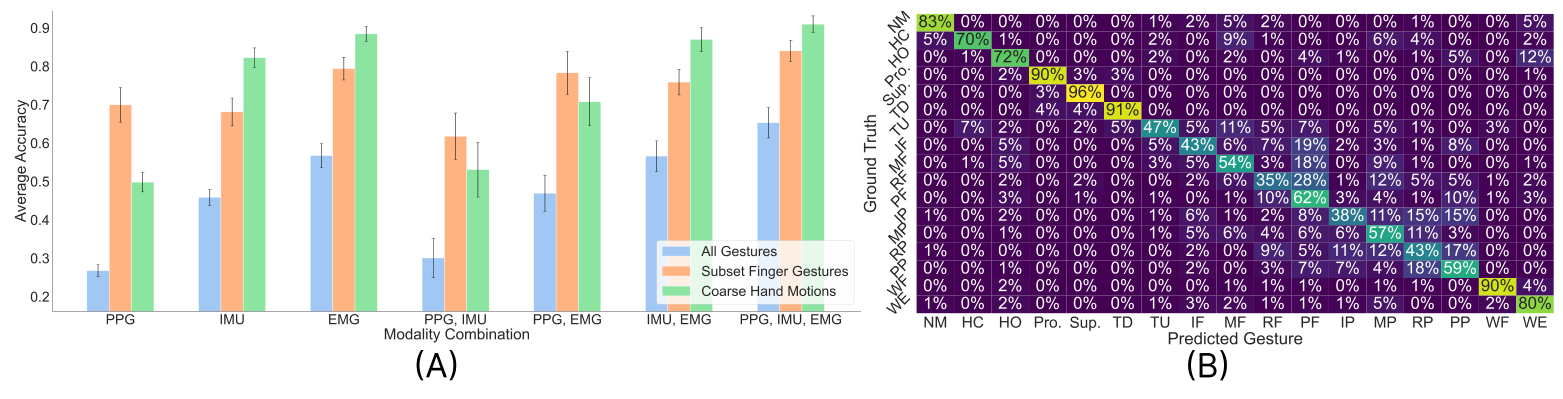
The combined system achieved 65.28% ± 10.45% accuracy across all seventeen classes and 90.98% ± 5.65% on the eight-class hand subset. These results show why the gesture vocabulary belongs beside the reported accuracy: reducing the set changed the difficulty substantially.
Combining modalities improved recognition across the evaluated gesture sets. PPG was relatively more useful for the selected finger subset, while EMG and inertial signals individually performed best on the coarse-hand set. This pattern supports complementary sensing within the studied task.
Participants also performed above the random-play reference in Myo Hero. However, online recognition remained challenging. The paper connects part of that difficulty to the mismatch between training on sustained contractions and encountering changing contractions during gameplay.
Reading the figures
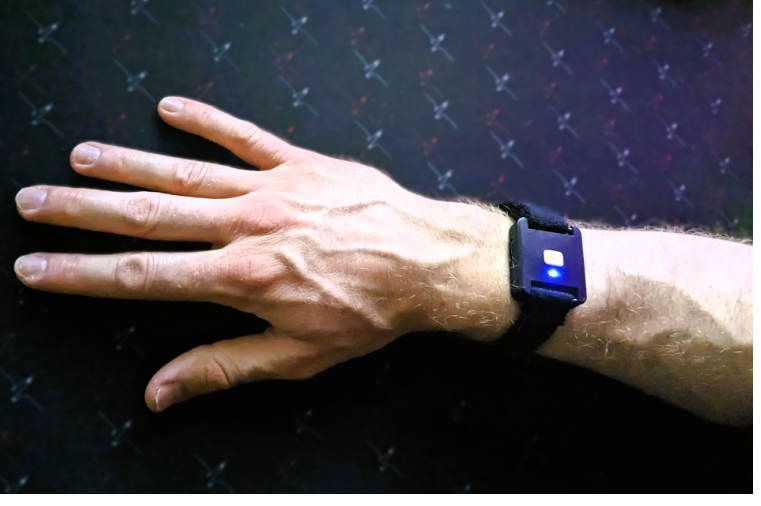
The photograph shows the small area used to collect the three signal types. Unlike a circumferential EMG array, it concentrates sensing at one wrist location.
That physical constraint motivates the fusion experiment. The photograph is an illustration of placement and form factor, not evidence that comfort or daily wearability was formally evaluated.
The gesture-set comparison is central to interpreting BioPoint’s accuracy. The left panel distinguishes all 17 classes from the smaller subsets; the right panel shows which full-set classes are confused. A strong result on coarse hand motions should not be generalized to the finer finger gestures visible in that matrix.
What the results do not establish
The study involved eight able-bodied participants and did not establish performance for people with upper-limb disabilities. Its motivation includes assistive interaction, but that application needs its own evaluation.
The discussion compares accuracy with published multichannel results, but those studies use different participants and gesture sets. That comparison is contextual, not a matched test of equivalence. Sustained-contraction training also leaves uncertainty about performance during natural transitions.
Looking back
A focused reading of the paper centres on the information available from the sensor combination and the task it can support. The difference between seventeen-class and subset performance is as informative as the feasibility result itself.
A direct continuation would collect transition-rich training data and test whether that improves the game’s timing and holding outcomes. A matched same-participant comparison with a multichannel device would separately address what is gained or lost by the smaller sensing area.
Read further
Xavier Isabel, Evan Campbell, Loïc Olivier, Gabriel Gagné, Erik Scheme, Ulysse Côté-Allard, and Gabriel Gagnon-Turcotte. BioPoint: Enhancing Human-Computer Interaction through Single-Site, Multi-Sensor Gesture Recognition. 46th IEEE EMBC, July 2024. DOI: 10.1109/EMBC53108.2024.10781656.
The acquisition and fusion sections describe the pipeline. Figure 6 compares modalities and gesture subsets; the Myo Hero section explains the online score. Isabel and Campbell contributed equally.