Can a force-estimation model reuse what it learned from other people while requiring less data from a new user? This paper tests that question using muscle and motion recordings during elbow flexion and extension.
We pretrained a multimodal network on a cohort, then fine-tuned it with a limited portion of the target person’s recordings. The focus was continuous force modelling and its calibration burden, rather than classification of a finite gesture vocabulary.
The question
The relationship between recorded EMG and force varies across people. Movement information can help explain force during dynamic contractions, but a model trained on other users still needs to accommodate the new user’s characteristics.
The study asked how much could be transferred, which layers should be updated, and how much target-user data was needed. A separate experiment asked whether the approach could also transfer from constrained contraction conditions to a more fully dynamic condition.
The study at a glance
- Participants
- Thirteen users performing elbow flexion and extension on a Biodex system.
- Inputs
- Twenty-eight differential EMG channels plus nine IMU channels.
- Conditions
- Isotonic, isokinetic, and fully dynamic contractions, evaluated separately.
- Metric
- Coefficient of determination, R², for estimated versus measured force; this is a regression score, not classification accuracy.
How we approached it
Separate convolutional branches extracted information from EMG and motion. Their outputs were combined before the layers that estimated force. This architecture lets the model use muscle activation and kinematics together.
We compared leaving all feature-extraction blocks trainable, freezing the early blocks, and freezing all convolutional blocks during personalization. We also compared several amounts of target-user data against a personal model trained from scratch and a cohort model used without adaptation.
Technical detail: the evaluation
The final contiguous 50% of the target user’s data formed a common test set. The principal model comparison used 20% for target-user training and 10% for validation; the transfer model and personal baseline received the same selected data.
Normalization statistics came from training data. In the separate condition-transfer experiment, isotonic and isokinetic recordings supplied training and adaptation, while fully dynamic recordings supplied testing. That experiment has a different split and should not inherit the principal experiment’s percentages.
What we found
Freezing all convolutional blocks gave the strongest overall personalization results in the ablation study, with significant advantages in the isokinetic and dynamic conditions over less restricted fine-tuning. The isotonic comparison did not show a significant difference between freezing all blocks and freezing the first two.
The resulting transfer approach outperformed the unadapted cohort model and the matched-data personal models across the three contraction conditions. The data-budget analyses supported useful transfer with relatively little target-user training, although the benefit and plateau depended on the condition.
Generalizing to a new contraction condition remained harder. Training and adapting on the two quasi-dynamic conditions gave mean R² values of 0.29 for transfer learning, −0.12 for the personal model, and −0.73 for the unadapted cohort model when tested on fully dynamic data. Transfer was significantly better, but an R² of 0.29 still leaves substantial unexplained error.
Reading the figures
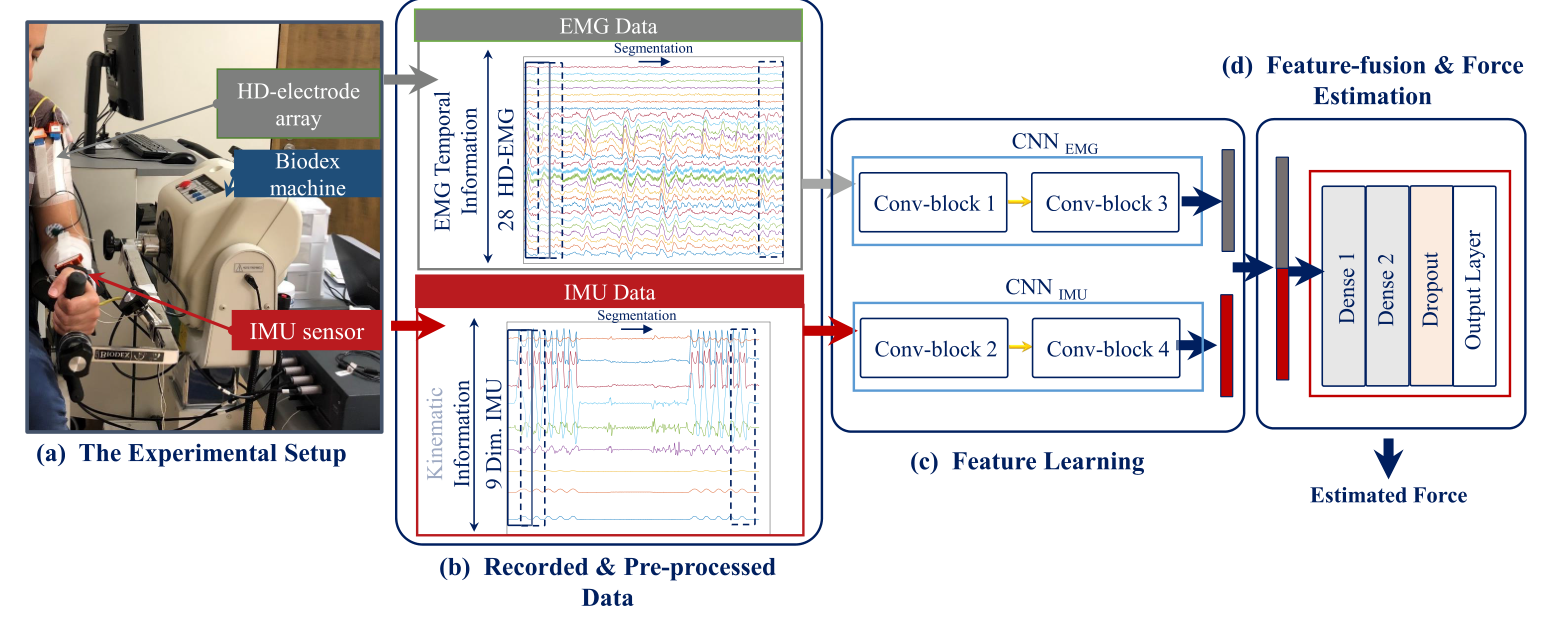
The two signal streams remain separate during initial feature learning and meet before force estimation. The diagram shows why the output can depend on both muscle activity and the movement associated with it.
The recording apparatus supplies the measured reference used for evaluation. The figure should not be read as a demonstration of an autonomous assistive device: the study assessed force estimates from the recorded experiments.
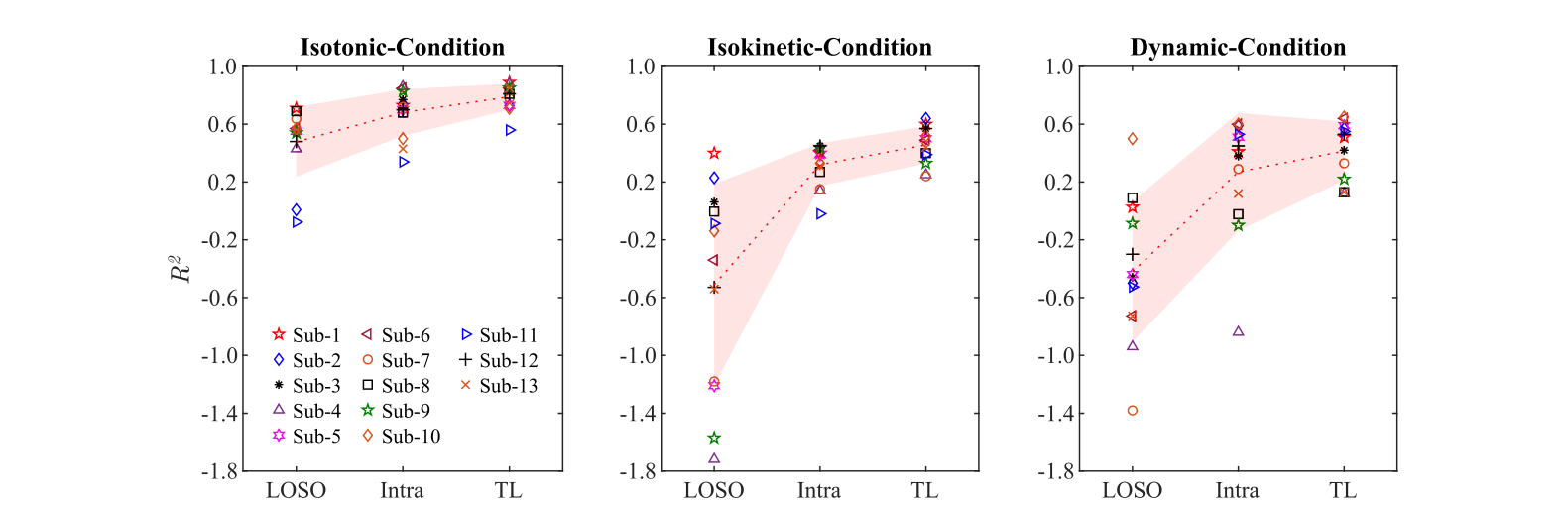
Each participant appears in the force-modelling comparison, so the plot exposes variation hidden by a single average. Read isotonic, isokinetic, and dynamic conditions separately, and compare transfer learning with the leave-one-subject-out and within-subject alternatives in each. Negative R² values are possible and signal poor prediction relative to a mean baseline.
What the results do not establish
The study uses controlled apparatus and a limited participant cohort. It does not establish equivalent performance during unrestricted daily activity or across changes in electrode placement between sessions.
Improvement over a weak baseline can be statistically meaningful without implying accurate absolute prediction. The condition-transfer R² values illustrate this clearly. Negative R² means the prediction error exceeds that of the relevant mean-reference predictor, not that force itself is negative.
Looking back
The specific contribution is a comparison under a matched new-user data budget. It shows that a small personal dataset can be used more effectively when it adapts a shared representation than when it must train the complete model alone.
A focused extension would test repeated sessions and sensor replacement while preserving that matched budget. The new-condition result also motivates targeted adaptation strategies for force-varying movements, where the current transfer remains incomplete.
Read further
Gelareh Hajian, Evan Campbell, Mahdi Ansari, Evelyn Morin, Ali Etemad, Kevin Englehart, and Erik Scheme. Generalizing Upper Limb Force Modeling With Transfer Learning: A Multimodal Approach Using EMG and IMU for New Users and Conditions. IEEE Transactions on Neural Systems and Rehabilitation Engineering 32, pp. 391–400, January 9, 2024. DOI: 10.1109/TNSRE.2024.3351829.
Figures 2–5 examine frozen layers, model comparisons, and data budgets. Figure 6 reports transfer to a new contraction condition and is essential for interpreting the generalization claim.