Can an adaptive EMG controller recover when the signal patterns change so much that its own predictions are no longer trustworthy? This paper tests that problem after a deliberate rotation of the recording armband.
We evaluated context-informed incremental learning (CIIL), using the cursor’s relationship to a target to inform model updates. The study separates improving a sparsely trained model from recovering a model after a large input shift—two situations that place different demands on adaptation.
The question
When a recognizer is already broadly correct, learning from its confident predictions may refine its boundaries. After an electrode shift, those predictions can instead reinforce the wrong mapping.
The study asked whether knowledge of the task could supply useful adaptation evidence even in that second situation. Positive context retained helpful actions; negative context corrected actions inconsistent with reaching or remaining on the target. Their combination was compared with unsupervised high-confidence adaptation.
The study at a glance
- Participants
- Thirty-two across two experiments: eleven for sparse training and twenty-one for electrode shift.
- Initial conditions
- One second per class in the first experiment; a conventionally trained model followed by a 45° cuff rotation in the second.
- Adaptation task
- Five-class cursor control in a target-acquisition game.
- Assessment
- Recorded-gesture metrics, separate online target acquisition, and workload ratings in the shift experiment.
How we approached it
The context rules used the current cursor and target positions to judge whether an action was suitable. The selected or corrected examples updated the LDA classifier incrementally during gameplay. Context did not simply steer the cursor directly to the target.
The first experiment examined two minutes of adaptation with constant-velocity control. The second used five minutes and proportional speed control after the cuff rotation. The longer adaptation interval allowed recovery trajectories to develop beyond the short pilot setting.
Technical detail: the evaluation
The two experiments differ in starting condition, control mapping, duration, and some context rules. They are complementary evaluations, not a controlled estimate of the isolated effect of changing just one variable.
After adaptation, a separate online assessment measured the resulting model. Noncompletion matters: a controller that cannot finish the task should not appear successful merely because conventional error measures omit the missing trials.
What we found
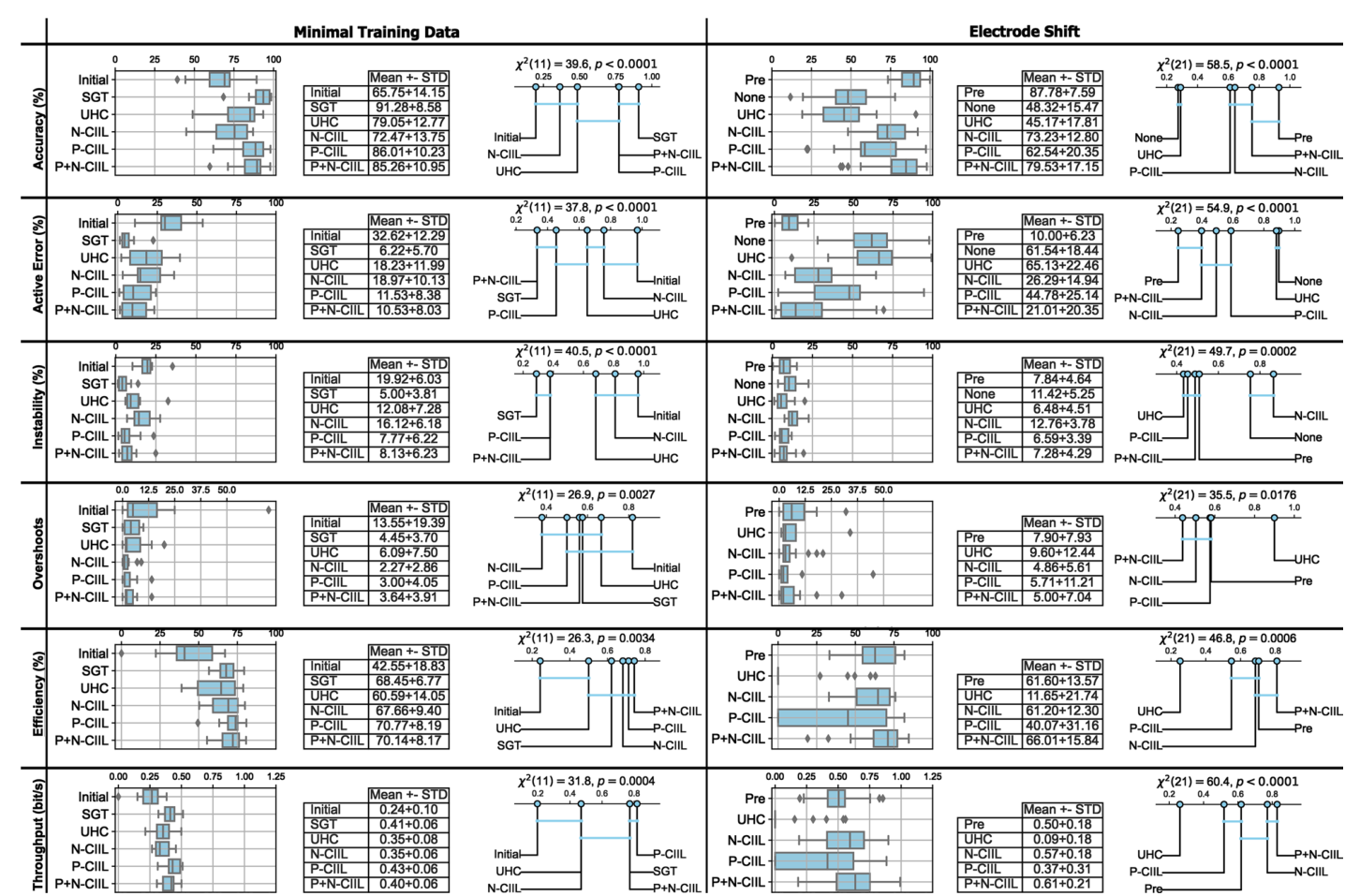
In the sparse-training experiment, positive context and combined context produced strong improvements over the initial model and confidence-based adaptation. This extends the earlier pilot with comparisons against conventional screen-guided training.
After electrode shift, only five of twenty-one participants recovered sufficiently with high-confidence adaptation to complete the usability test. Positive context alone enabled recovery for fourteen. Strategies incorporating negative context enabled all participants to recover usable control in the reported experiment.
The combined strategy achieved 0.61 bits/s mean throughput after adaptation, compared with 0.50 bits/s for the pre-shift model. Offline classification told a different part of the story: the pre-shift model averaged 87.78% accuracy and the combined adapted model 79.53%, with no significant difference reported between those two conditions. Improved interactive control should therefore not be equated with higher accuracy on prompted recordings.
Reading the figures
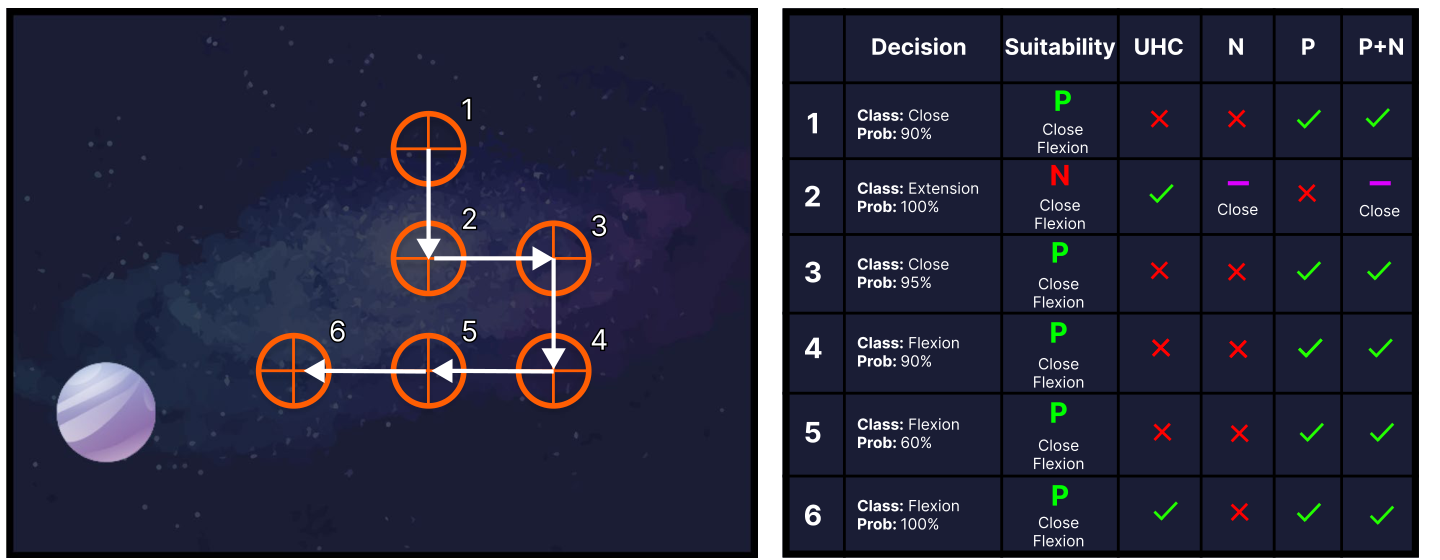
Each numbered cursor position corresponds to a row in the table. The table separates the classifier’s prediction from whether that prediction is suitable for the target and how each strategy would use it.
This makes the role of negative context explicit: an unsuitable action can become a corrected training example rather than being discarded. It also exposes ambiguity when more than one direction could move toward the target.
The two scenario columns keep the minimal-training and electrode-shift experiments separate. Within each, compare the offline prediction measures with the online control measures. The summary statistics and critical-difference diagrams prevent the strongest visible improvement from being treated as a blanket result across all outcomes. Select the image to read the individual comparisons.
What the results do not establish
The environment supplied precise cursor and target information. Many applications would provide noisier or incomplete context, and the study does not establish the accuracy or frequency of context required for reliable recovery.
The 45° shift is one controlled perturbation. It does not demonstrate resilience to all combinations of fatigue, position, sensor contact, and long-term changes. Contextual suitability also remains a proxy for intent: a movement toward the target can still be unintended.
Looking back
The central distinction is between refining a usable mapping and escaping an unusable one. The change in strategy effectiveness across the two experiments is evidence that those adaptation problems should be evaluated separately.
A focused extension would deliberately corrupt or withhold portions of the task context and measure recovery probability and time. That would test the dependency that matters most when moving this method beyond a fully instrumented cursor task.
Read further
Evan Campbell, Ethan Eddy, Scott Bateman, Ulysse Côté-Allard, and Erik Scheme. Context-Informed Incremental Learning Improves Both the Performance and Resilience of Myoelectric Control. Journal of NeuroEngineering and Rehabilitation 21, 70, 2024. DOI: 10.1186/s12984-024-01355-4.
The experimental-design section distinguishes the two scenarios. Figure 4 reports both offline and online outcomes; the adaptation-dynamics discussion explains noncompletion and recovery.