Can publicly available EMG data support a live interface without collecting calibration gestures from each new user? This paper tests two such interfaces and releases the models and code needed to reproduce them.
We moved beyond offline classification to a one-dimensional cursor task and a discrete prompted-gesture task. The contribution is an openly reproducible demonstration of calibration-free interaction within those tasks, rather than a claim to match every capability of proprietary systems.
The question
Large cross-user datasets can yield promising held-out accuracy, but an interactive system also needs to handle ongoing input, uncertain contractions, gesture boundaries, and feedback to the user.
The paper asked whether those pieces could be assembled using an established research armband and open resources. It also measured familiar input-device baselines to put the resulting interaction times in context.
The study at a glance
- Source data
- The public 612-participant EMG-EPN dataset, with task-specific preparation.
- Cursor study
- Twenty participants; wrist flexion/extension controlled one-dimensional cursor velocity.
- Gesture study
- Fifteen participants, overlapping with the cursor sample; prompted discrete gestures.
- Calibration
- No calibration recordings from evaluation participants; instructional guidance and task practice were provided.
How we approached it
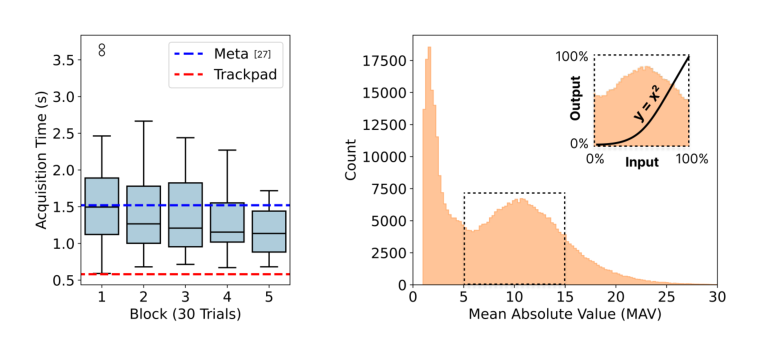
The continuous model used a task-specific subset of the public data and a convolutional network for flexion, extension, and rest. Low-confidence outputs were rejected, while contraction intensity was mapped quadratically to cursor speed.
The discrete model combined convolutional and recurrent layers. Additional daily-activity recordings from separate people helped represent non-command input. A sliding-window decision procedure and repeated-prediction criterion converted the model into an event detector.
These surrounding decisions are part of the result. Calibration-free operation depends on the complete pipeline, not simply taking an offline classifier and running it continuously.
Technical detail: the evaluation
For continuous-model preparation, 162 public-dataset participants were excluded by a within-user accuracy criterion, leaving 420 for training and thirty for validation. This was a data-selection rule, not evidence that those excluded people could never use the live interface.
The cursor used velocity control and allowed a simple speed preference. It did not estimate absolute wrist position. The discrete task’s response time includes reaction and gesture execution, while cursor acquisition time excludes the half-second dwell.
What we found
Cursor acquisition improved with practice: reported mean time decreased from 1.63 seconds in the first analysis block to 1.15 seconds in the final block. The trackpad baseline was 0.58 seconds and significantly faster than every EMG block.
For discrete gestures, mean response time was 1.03 seconds in the final block. First-attempt error was 2.4%, falling to 0.5% when a second attempt was allowed. These are separate measures; describing the latter as first-attempt accuracy would overstate the result.
One false activation occurred during the discrete-task evaluation. This is useful online evidence, but the prompted task is not an unrestricted daily-activity test. Participant mistakes in producing the requested gesture were retained as errors rather than removed from the analysis.
Reading the figures
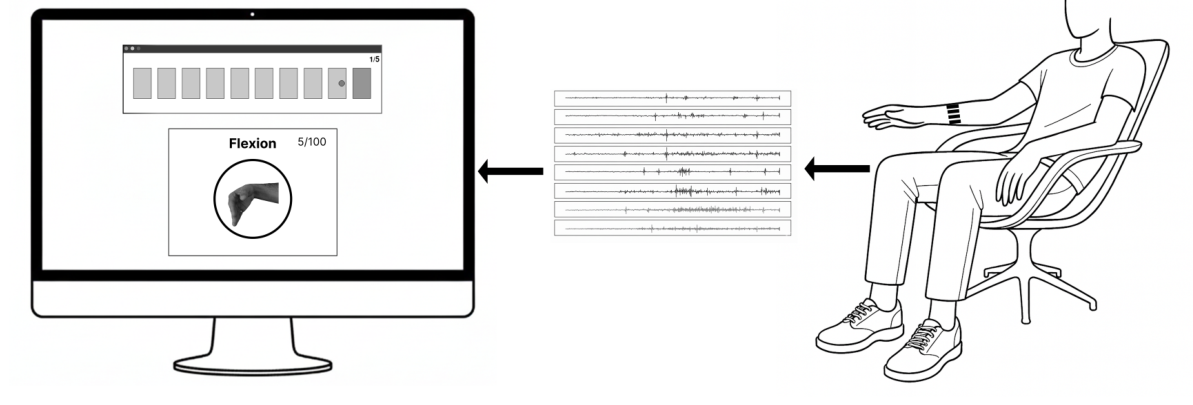
The display illustrates the two output tasks: continuous cursor movement and a discrete response to a gesture prompt. Both use a model prepared before the new participant begins.
Calibration-free describes the absence of user-specific training recordings. It does not mean no instructions, no practice, or no constraints on how the armband is worn.
The acquisition-time plot shows practice across evaluation blocks, while the adjacent histogram explains the contraction-to-speed mapping. The trackpad line is the study’s baseline. The Meta reference is contextual because its control mapping and protocol differ; the graph should not be read as a controlled head-to-head comparison with that system.
What the results do not establish
The live studies used the same device family as the public training data. They do not establish cross-hardware transfer or robust use across every session and activity.
The comparison with proprietary demonstrations is only contextual. Gesture sets, control mappings, and task parameters differ, so the timings do not support a direct superiority claim. The paper also did not implement handwriting recognition or general multi-degree-of-freedom control.
Looking back
The specific advance is an accessible, live test of calibration-free models with the complete processing and interaction pipeline available for scrutiny. The familiar-device baselines and learning curves make the result more informative than a single best-case error rate.
A focused continuation would repeat the online tasks across days and include extended unrelated activity between commands. Evaluating users whose recordings would fail the training-data quality filter would also help assess how that selection affects coverage.
Read further
Ethan Eddy, Evan Campbell, Erik J Scheme, and Scott Bateman. Open, Accurate, and Calibration-Free Muscle-Computer Interfaces. ACM CHI 2026, April 13–17, 2026. DOI: 10.1145/3772318.3790689.
Sections 3.3–3.4 document model preparation and the new-user protocol. Sections 4.1–4.2 separate practice blocks, response time, first-attempt errors, and retry outcomes.