How should a regression controller learn from target-directed movement when the user does not always take the mathematically shortest path? This paper tests contextual labels that tolerate some deviation from that assumed behaviour.
We compared two adaptive regressors with two screen-guided-training baselines under an equal training-time budget. The focus was simultaneous proportional control, including drift near rest and unintended activity on another degree of freedom.
The question
Regression can produce two control outputs at once, but a nonzero output on both axes is useful only when both are intended. A controller that moves quickly but drifts near neutral or activates the wrong axis can still be difficult to use.
The study asked whether learning from interactive behaviour could improve those properties and whether contextual labels should account for pauses and partially correct movement. This distinguishes useful simultaneous control from simply increasing the amount of simultaneous output.
The study at a glance
- Participants
- Sixteen participants, eight male and eight female, aged 22–32.
- Signals and outputs
- Eight-channel Myo EMG; a neural network predicting two velocity-control components.
- Equal training budget
- 300 seconds per model: all prompted training, or 50 seconds prompted plus 250 seconds adaptive use.
- Validation
- Five-minute Fitts-style task with polar visualization and measures of throughput, efficiency, drift, and action interference.
How we approached it
The two fixed models used isolated contractions only, or a mix of isolated and combined contractions. The adaptive models started with the same short isolated-contraction calibration and then learned from the target task.
The oracle-style CIIL rule pointed its labels directly toward the target, with magnitude related to target distance. The tolerant rule instead considered which components of the predicted movement were suitable, excluded some fully unsuitable movements, and avoided treating low-activity pauses as intended high-amplitude commands.
Technical detail: the evaluation
The first twenty validation trials were treated as warm-up and excluded. Timed-out trials remained in the performance calculations with a ten-second movement time, preventing failure from disappearing entirely from the metrics.
The same network architecture was used for all training protocols. The model order was balanced, and participants were not told which model they were using. These choices support a training-protocol comparison rather than an architecture comparison.
What we found
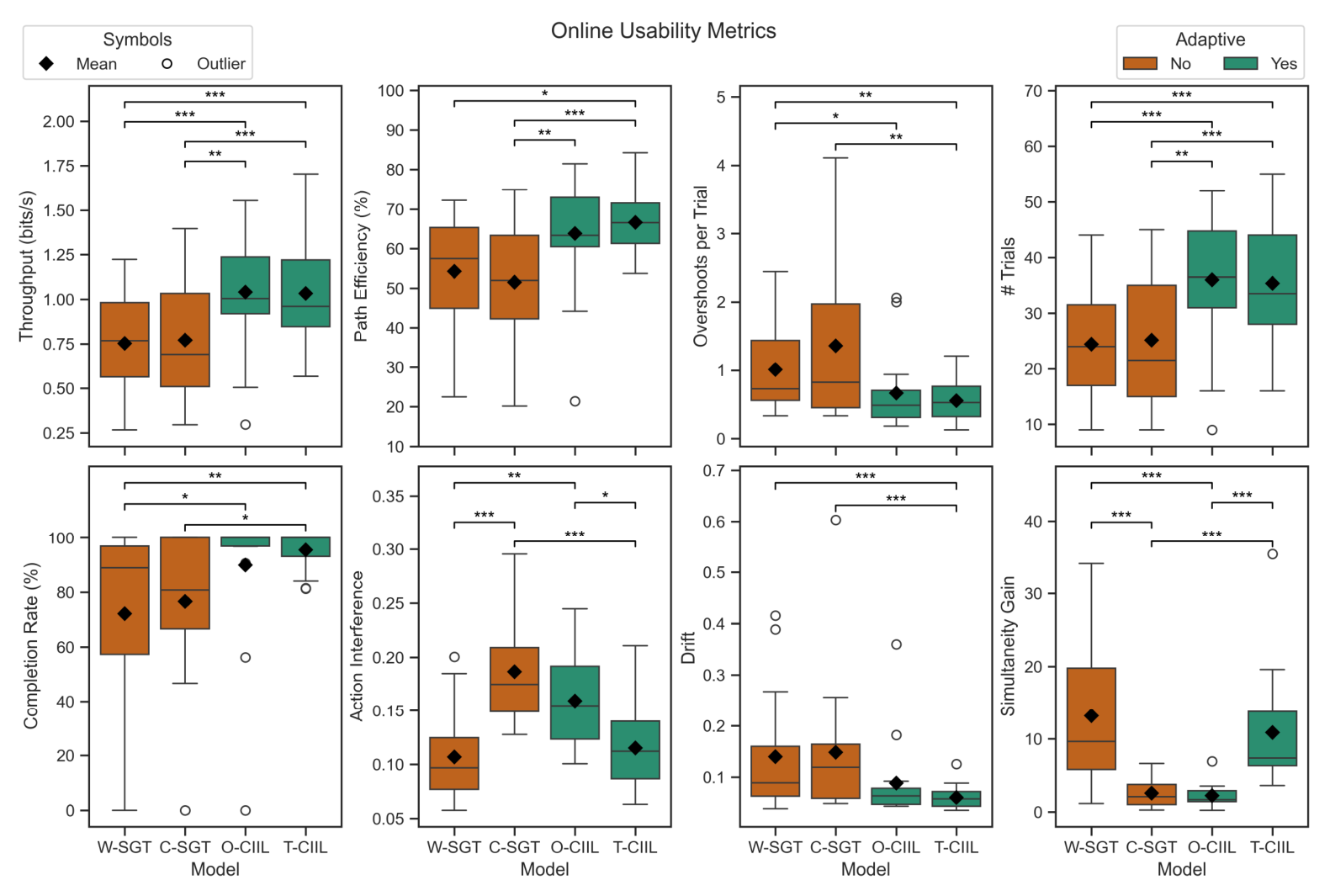
Both adaptive approaches improved average online performance over the non-adaptive protocols on most measures. The tolerant model significantly exceeded the combined-motion SGT model across the reported usability measures and exceeded the isolated-motion model on most measures.
The strongest significant difference between the two adaptive approaches in the main comparison concerned action interference. The tolerant strategy reduced unwanted cross-axis activity while preserving useful task performance. Other apparent advantages between the adaptive models should not all be described as significant.
Adding combined contractions to fixed calibration increased simultaneous output, but also introduced costs in stability and efficiency. Likewise, fitting the original prompted labels more closely did not capture the whole benefit of the adapted controllers. The results favour evaluating the quality of simultaneous control, not its frequency alone.
Reading the figures
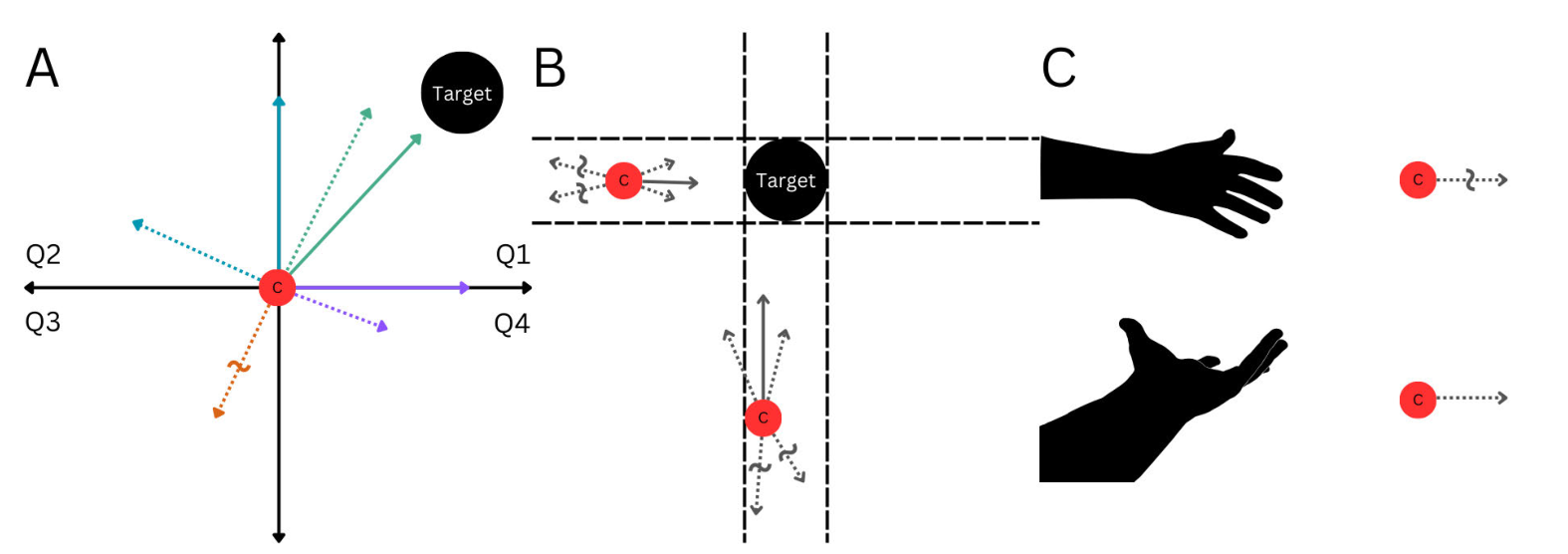
The arrows distinguish the observed prediction from the label used for learning. Different rules apply when one component is useful, when the cursor already aligns with the target on an axis, and when there is insufficient muscle activity to justify a movement label.
The diagram explains how the method relaxes an assumption about user compliance. It still uses task context; it does not independently measure the exact movement the user intended.
The complete outcome panel helps keep the regression findings specific. Compare throughput and drift alongside completion, interference, and simultaneous control; the significance brackets identify supported differences. The tolerant and oracle adaptive methods should not be described as significantly different on every measure merely because their medians differ.
What the results do not establish
The target geometry supplied contextual information, and the distance-to-output rule remained an assumption. Tolerant labels reduce some errors in that assumption without making every pseudo-label correct.
The study concerns two-degree-of-freedom laboratory control and short adaptation periods. It does not establish equivalent performance for a multi-joint prosthesis or over repeated daily sessions. The isolated-motion baseline also remained competitive on measures that reward avoiding simultaneous output.
Looking back
The paper’s contribution is the link between contextual-label assumptions and particular control failures. Drift and action interference provide more specific evidence than a single overall score.
A focused next experiment would vary the amount of delayed, indirect, or paused movement while keeping target difficulty fixed. That would test where tolerant labels help and where a richer model of intended behaviour is required.
Read further
Christian Morrell, Evan Campbell, Ethan Eddy, and Erik Scheme. Context-Informed Incremental Learning Improves Throughput and Reduces Drift in Regression-Based Myoelectric Control. IEEE Transactions on Neural Systems and Rehabilitation Engineering 33, pp. 1841–1852, May 5, 2025. DOI: 10.1109/TNSRE.2025.3567245.
The model definitions distinguish W-SGT, C-SGT, O-CIIL, and T-CIIL. Figures 3 and 5 explain the tolerant labels and the online comparisons; the validation section documents warm-up and timeout handling.