“Adaptive myoelectric control” includes methods with very different sources of information and very different goals. This review organizes those distinctions so that their assumptions and capabilities can be compared more clearly.
We developed a taxonomy of incremental-learning strategies and a separate taxonomy of learning goals. The paper is a narrative synthesis arising from a neurorehabilitation workshop and subsequent contributions, rather than a pooled statistical comparison of interventions.
The question
A controller may update from its own predictions, from unlabelled signal structure, from task feedback, or from another explicitly labelled calibration session. Calling all of these unsupervised adaptation hides their different dependencies.
Likewise, maintaining an existing gesture after electrode displacement is different from learning a new muscle pattern for the same command or adding an entirely new command. The review asks which distinctions make the literature easier to interpret and which problems remain inadequately studied.
The study at a glance
- Review type
- Narrative review informed by a 2024 International Conference on NeuroRehabilitation workshop and expert contributions.
- Strategy taxonomy
- Dedicated on-demand recalibration, unsupervised incremental learning, predictor-dependent learning, and environment-dependent learning.
- Goal taxonomy
- Domain-incremental, task-incremental, and class-incremental continual learning.
- Additional themes
- Transfer, regression, physiological representations, end-effector design, user acceptance, and human–model co-adaptation.
How we approached it
The strategy taxonomy follows the source of information used to update the model. Dedicated recalibration obtains explicit labels. Unsupervised methods exploit structure in the incoming data. Predictor-dependent methods use the recognizer’s outputs, often filtering them for confidence or consistency. Environment-dependent methods use external task information, contextual labels, or rewards.
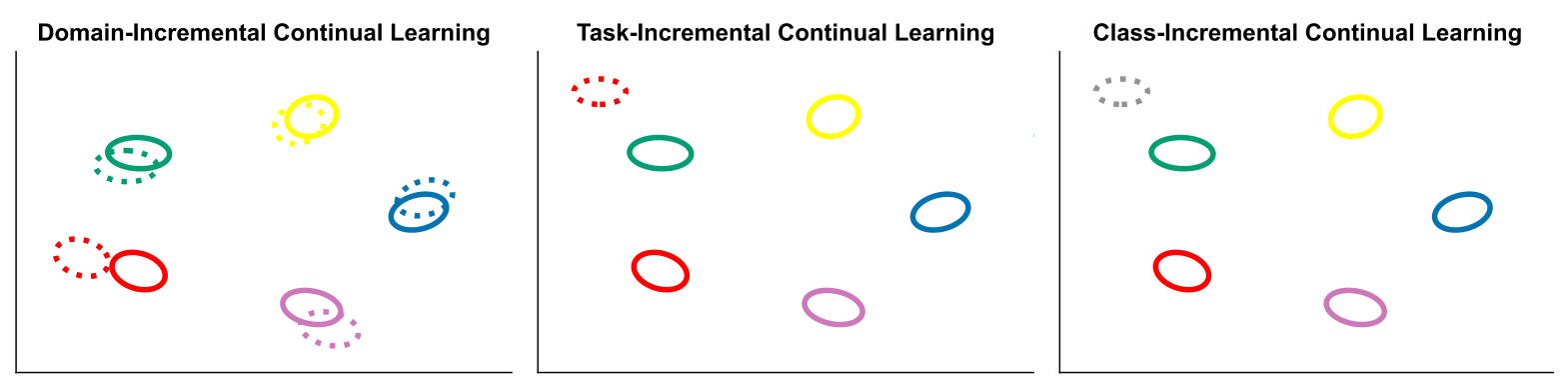
The goal taxonomy then asks what changes. Domain-incremental learning accommodates variations in existing patterns. Task-incremental learning, as framed here, accommodates new patterns for existing actions. Class-incremental learning expands the set of actions. A method’s source of labels does not automatically determine which of these goals its architecture supports.
Technical detail: the evaluation
The review assembles representative studies and conceptual comparisons rather than applying a systematic-review search protocol or calculating a pooled effect size. Its tables should be used to locate relevant evidence, not to infer a universal numerical ranking.
The distinction between user adaptation and model adaptation is also deliberate. Better task performance over time may reflect changes in either learner, and a co-adaptive study needs measures that can help distinguish them.
What we found
The synthesis identifies a recurring limitation of predictor-dependent updates: they can refine a broadly correct mapping, but may reinforce errors after a large change. External labels or context can provide a corrective signal, although they introduce their own collection or perception requirements.
The learning-goal distinction exposes another limitation. Adding a new input pattern for an existing action may require a multimodal class representation. Adding a new output requires structural support beyond updating parameters of a fixed classifier. Success at compensating for drift does not establish either capability.
The review also identifies unresolved questions about separating noise from behavioural change, matching model complexity to available adaptation data, and coordinating user learning with algorithm updates. These are research gaps and organizing arguments, not new experimental measurements produced by the review.
Reading the figures
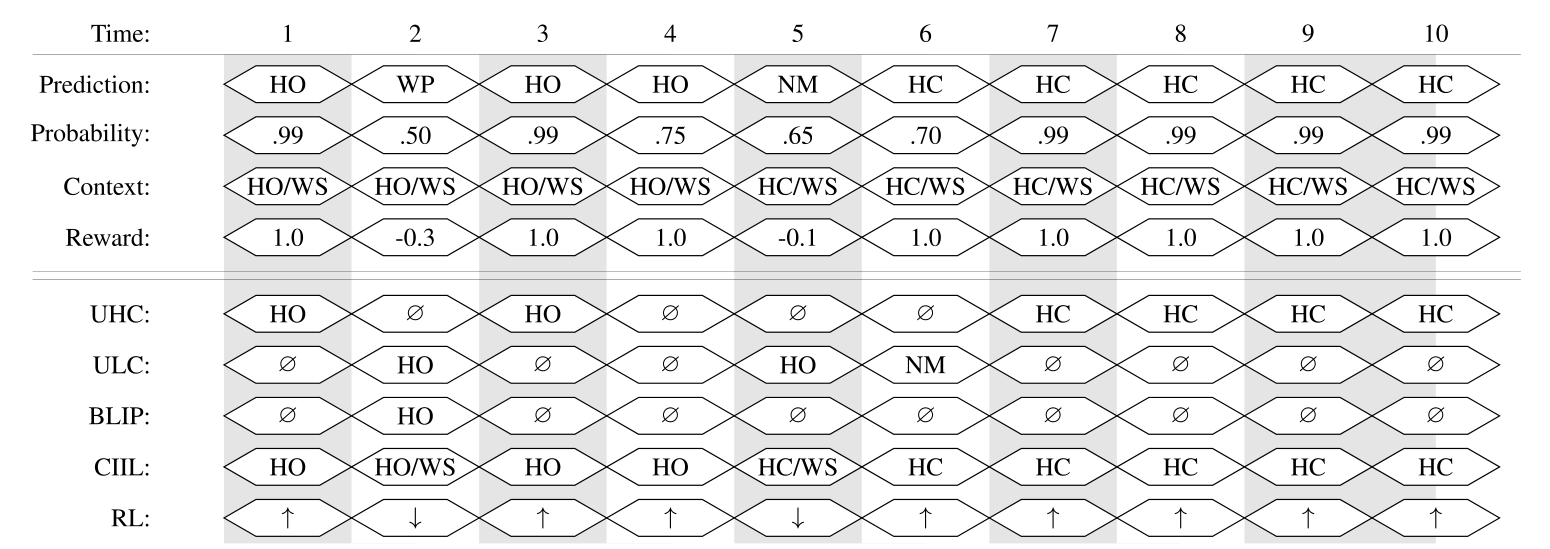
Read each column as the same moment in a hypothetical interaction. The rows show which information is available and how different learning strategies act on it.
A high-confidence filter may retain one prediction while a context-based method corrects it. A reward-based method receives another form of feedback again. The diagram compares information flow, not measured performance between those methods.
The taxonomy figure separates three learning goals: adapting existing patterns, learning a new pattern for an existing output, and adding a new output class. The ellipses and points are a conceptual feature-space illustration, not measured clusters from a new experiment. That distinction is essential for reading a review’s framework.
What the results do not establish
A taxonomy is a tool for comparison, not proof that one category is best. Strategies can be combined, and effectiveness depends on the quality of feedback, the model, and the intended control task.
The reviewed studies differ in participants, devices, duration, and outcomes. In particular, improvements in offline prediction cannot be assumed to establish long-term functional benefit or user acceptance.
Looking back
The paper’s contribution is a more precise vocabulary for designing and interpreting adaptation experiments. A useful description states both where the update information comes from and whether the goal is drift compensation, remapping, or an expanded action set.
A focused next step would benchmark strategies under those distinct goals while varying feedback reliability and measuring user learning separately. That would turn the review’s conceptual distinctions into controlled experimental comparisons.
Read further
Evan Campbell, Fabio Egle, Marius Oßwald, Ulysse Côté-Allard, Patrick M. Pilarski, Nicolò Boccardo, Roberto Meattini, Ivan Vujaklija, Levi Hargrove, Michele Canepa, Ethan Eddy, Alessandro Del Vecchio, Claudio Castellini, and Erik Scheme. (Un)supervised (Co)adaptation via Incremental Learning for Myoelectric Control: Motivation, Review, and Future Directions. IEEE Transactions on Neural Systems and Rehabilitation Engineering 33, pp. 3565–3582, August 25, 2025. DOI: 10.1109/TNSRE.2025.3602397.
Sections III–IV define the two taxonomies; Sections V–VII connect them to representative work and open questions. Campbell and Egle contributed equally.