A hand movement can be a command at one moment and part of another activity at the next. This preprint examines a way to make that distinction explicit: use a recognizable finger snap to enter and leave an active control mode.
We evaluated wake-gesture detection while participants alternated between everyday activities and two control tasks. This post discusses the original 2024 manuscript; the later journal paper is a related version of the work, not an independent replication.
The question
A conventional continuous classifier keeps interpreting EMG while the user types, writes, or handles a phone. A rest class cannot cover all those active but unrelated movements.
The paper asks whether a short temporal gesture can serve as a reliable gate around that classifier. The problem is mode switching: detecting that control is intended before allowing the underlying gesture predictions to act on the application.
The study at a glance
- Version and sample
- The February 2024 preprint reports twenty participants.
- Detector
- Dynamic time warping (DTW) compares incoming one-second EMG sequences with twenty personal wake-gesture templates.
- Underlying controller
- Five-class LDA using an eight-channel Myo Armband.
- Online tasks
- Dismissing an alarm and steering a Sphero robot, interspersed with walking, writing, typing, simulator driving, and phone use.
How we approached it
The continuous recognizer kept producing predictions, but a separate state determined whether they could reach the application. A detected finger snap toggled between sleep and active control.
DTW compared the temporal pattern of root-mean-square EMG features while allowing limited timing differences. A personal distance threshold controlled how closely a candidate had to match the recorded snaps. Threshold selection deliberately favoured avoiding unintended activation over accepting every attempted snap.
Technical detail: the evaluation
The wake detector evaluated a sliding one-second template every 50 ms. Its negative opportunities therefore greatly outnumbered intentional wake gestures. A very low false-positive percentage should be read alongside the actual event counts and the missed-snap rate.
The robot and alarm tasks supplied different contexts for intentionally invoking control. The main outcome was wake detection, not how quickly or accurately the underlying classifier steered the robot.
What we found
The preprint reported a median false-positive rate of zero and no false activations for eighteen of twenty participants. It also documented an outlier with seven false positives; the result was not zero unintended activation for everyone.
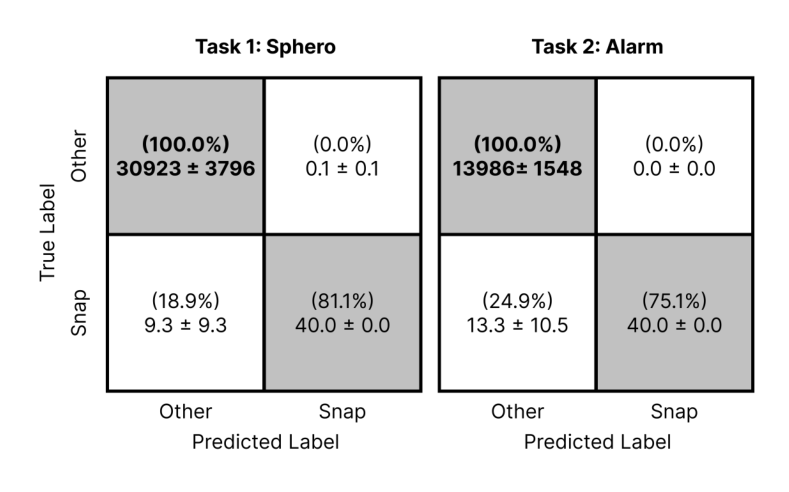
Reported true-positive rates were 81.1% for the robot task and 75.1% for the alarm task. The corresponding missed-snap rates show the cost of conservative gating. Two participants were excluded from the principal confusion-matrix analysis: one with unusually many missed snaps and one with the seven false positives.
The alternative wake gestures were evaluated afterward on recorded activity, rather than used interactively by participants. Their receiver-operating curves support further investigation, but do not give them the same online evidence as the finger snap.
Reading the figures
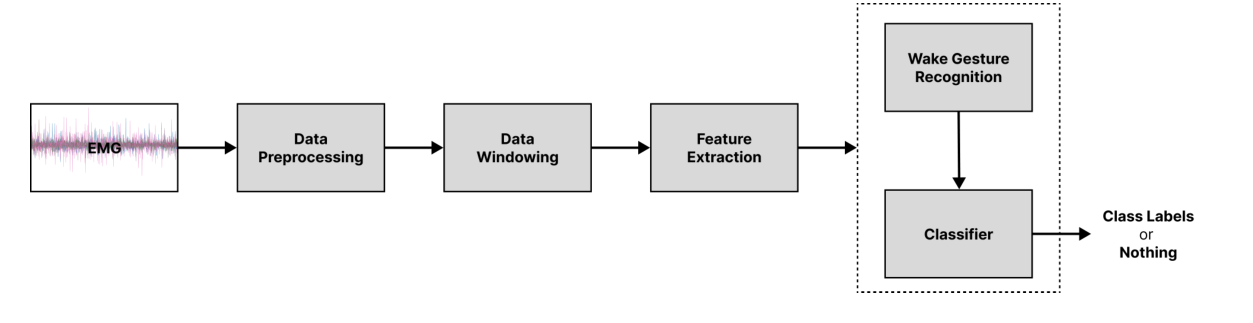
The wake detector sits alongside the ordinary classifier. Its role is to enable or silence outputs, not to improve the classifier’s distinction between hand-open and wrist-flexion contractions.
This separation explains the contribution: everyday muscle activity can still look like a command to the underlying model, while the inactive gate prevents that prediction from reaching the device.
The confusion matrices show the trade-off behind the wake gate: out-of-set activity was rarely accepted, while some intentional snaps were missed. Read the lower-left cells as missed wake gestures, not wrong downstream commands. These matrices use the main analysis after the reported exclusions and describe the same experiment later presented in the journal article.
What the results do not establish
The outlier exclusions materially affect the headline detection rates and should remain visible. The recorded activities and short sessions also do not establish zero false activations throughout unrestricted daily use.
Finger snapping may be difficult, tiring, or socially unsuitable for some users. This version did not test a clinical limb-loss cohort, long-term electrode changes, or a calibration-free detector.
Looking back
The paper’s focus is an explicit tradeoff in mode control. It provides an online example of suppressing unintended commands by requiring a distinctive action first, while documenting the burden of missed activation attempts.
A focused continuation would retain all participants in the primary analysis and measure consecutive missed attempts, false mode changes per hour, and recovery effort over longer sessions. Those outcomes directly reflect the costs the wake gate is intended to manage.
Read further
Ethan Eddy, Evan Campbell, Scott Bateman, and Erik Scheme. On-Demand Myoelectric Control Using Wake Gestures to Eliminate False Activations During Activities of Daily Living. arXiv preprint 2402.10050v1, February 15, 2024. DOI: 10.48550/arXiv.2402.10050.
Sections III-D–F describe the detector and tasks; Section IV-B documents detection outcomes and exclusions. The related journal version is DOI 10.1088/1741-2552/ada4df and has its own entry in this series.