Does context-informed learning help when the task involves grasping and moving objects rather than steering a two-dimensional cursor? This study tests that extension in virtual reality.
We used each virtual object’s allowed grasps and the hand’s proximity to it to inform incremental classifier updates. The objective was to examine object-transport performance and perceived workload, alongside the usual accuracy on prompted gesture recordings.
The question
A person reaching for an object may use different contractions from those demonstrated during isolated calibration. The object also supplies information about plausible actions: a pinch may be appropriate for a small item, while another object permits several grasps.
The study asked whether that information could improve recognition during the task without selecting the grasp directly for the user. It extends the contextual-learning question to a setting with spatially tracked hands and object-specific alternatives.
The study at a glance
- Participants
- Nine people without upper-limb differences.
- Signals
- Eight-channel SiFiBand EMG at 2,000 Hz; only EMG from the multimodal device was used.
- Task
- Transport six virtual objects between two tables within five minutes.
- Comparison
- The same initial classifier with or without live contextual adaptation; trial order randomized.
How we approached it
Initial screen-guided training collected three three-second repetitions per gesture. The gesture set included several grasps, wrist movements, and rest. The VR environment tracked hand position with the headset and defined which grasps were valid for each object.
Within an object’s 10 cm grasping radius, a compatible prediction received positive context. An incompatible prediction received a soft label distributed over valid alternatives. Label spreading refined these examples, and the classifier updated every two seconds during the adaptive trial.
The contextual label guided learning; it did not replace the current classifier decision. This matters because a system that automatically chose a valid grasp would be evaluating a different form of assistance.
Technical detail: the evaluation
Post-task prompted recordings evaluated the classifier separately from the object task. NASA-TLX ratings used a 1–20 workload scale, where lower values indicated less perceived workload.
The two conditions used the same functional goal but different learning behaviour. The reported means describe this nine-person comparison; the paper does not provide a large confirmatory trial or establish every apparent difference as statistically significant.
What we found
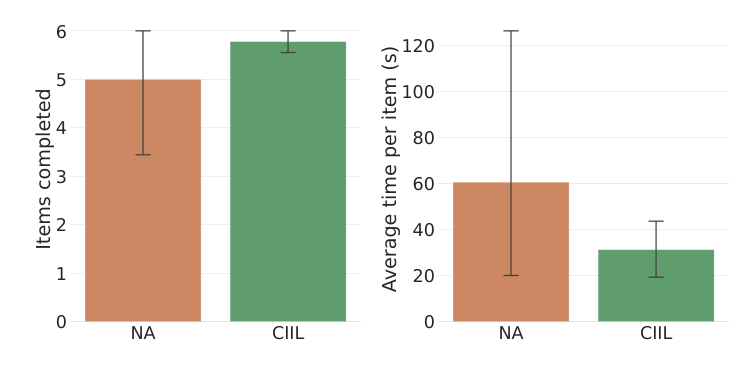
Participants completed an average of 5.78 of six objects with CIIL, compared with 5.00 without adaptation. Mean time per object was 31.26 seconds with CIIL and 60.59 seconds without it. The non-adaptive timing had substantial variability, so the means should not be interpreted as a guaranteed halving for each participant.
Mean workload was 7.55 with adaptation and 8.97 without adaptation on the reported 1–20 scale. Reporting those values directly avoids ambiguity about percentage reductions and scale normalization.
Post-task prompted accuracy was 73.87% after CIIL and 79.64% after the non-adaptive trial, a difference of approximately 5.8 percentage points. Initial accuracy was 73.68%. Thus the lower post-CIIL accuracy relative to post-NA did not correspond to worse transport performance.
Reading the figures
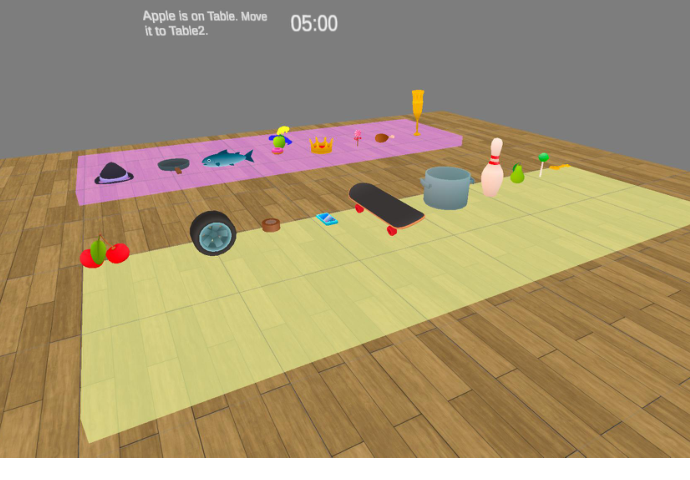
The objects provide both a functional goal and the source of contextual alternatives. Their locations and allowed grasp sets determine which classifier outputs are considered suitable during learning.
This is a virtual transport task. Real grasp forces, contact mechanics, and physical object damage were not measured, even though the environment was designed to resemble functional manipulation.
The online results directly measure the object-transport task: completed items and time per item. The error bars make the small sample’s variability visible. These task outcomes should be considered alongside the offline accuracy result, which did not move in the same favourable direction after adaptation.
What the results do not establish
The sample was small and did not include people with upper-limb differences. The study therefore supports feasibility in the tested VR task, not clinical effectiveness.
Hand tracking and predefined valid grasps supplied relatively clear context. Physical environments would require perception and contact information with their own errors. The short sessions also leave open how accumulated label errors affect longer-term adaptation.
Looking back
The specific advance is using object-related context to learn during grasping and transport. Keeping task outcomes, workload, and prompted accuracy separate reveals what improved and what did not.
A focused continuation would test ambiguous objects with several plausible grips and deliberately imperfect tracking. A physical transfer task could then examine whether the contextual labels remain useful when contact and load change the contractions.
Read further
Gabriel Gagné, Anisha Azad, Thomas Labbé, Evan Campbell, Xavier Isabel, Erik Scheme, Ulysse Côté-Allard, and Benoit Gosselin. Context Informed Incremental Learning Improves Myoelectric Control Performance in Virtual Reality Object Manipulation Tasks. 47th IEEE EMBC, July 2025. DOI: 10.1109/EMBC58623.2025.11252918.
Table I describes the procedure. Figures 2–3 define valid grasps and the environment; Figures 5–6 and Table III report accuracy, transport, and workload.