Can an EMG recognizer identify a new person’s gestures without collecting calibration data from them? This paper tested that question at a larger scale than the small participant pools common in earlier myoelectric-control studies.
We used the public EMG-EPN612 dataset and treated each complete dynamic gesture as one event. A series of analyses then examined training-set size, demographic representation, personal fine-tuning, and transfer to separately collected recordings.
The question
A model can generalize to another repetition from a familiar person without generalizing to a new person. Zero-shot evaluation requires the latter person’s data to be absent from model training and calibration.
The paper asked whether a much larger pool of users, combined with modelling the whole gesture’s temporal structure, could make that stronger form of generalization practical. It also asked how the result changed when the training population or recognition conditions changed.
The study at a glance
- Main dataset
- EMG-EPN612: 612 participants recorded with the Myo Armband.
- Principal split
- 306 training-pool users and 306 separate test users; the LSTM reserved six training-pool users for validation.
- Output
- One prediction per segmented gesture; six classes including rest.
- Additional evaluation
- A separately collected 14-person Myo DisCo dataset using the same recording device.
How we approached it
We compared conventional window-based recognition combined by majority vote with sequence-based methods. The long short-term memory network (LSTM) receives a sequence of feature windows and learns how the gesture develops over time before producing a single class prediction.
The mini-studies varied the number of training users and repetitions, examined feature representations and gesture subsets, and tested optional transfer learning. The separate Myo DisCo recordings tested whether the model’s performance extended beyond the original dataset under changes in day, position, and gesture speed.
Technical detail: the evaluation
The primary zero-shot LSTM used 300 users for weight training and six for validation, then tested on 306 unseen users. The test analysis used the repetitions whose labels were public.
The training-size experiments used their own explicitly defined pools and fixed test cohorts. Their threshold results should not be combined as if they came from one unchanged test set. Fine-tuning analyses also introduce new-user data and therefore cease to be zero-shot.
What we found
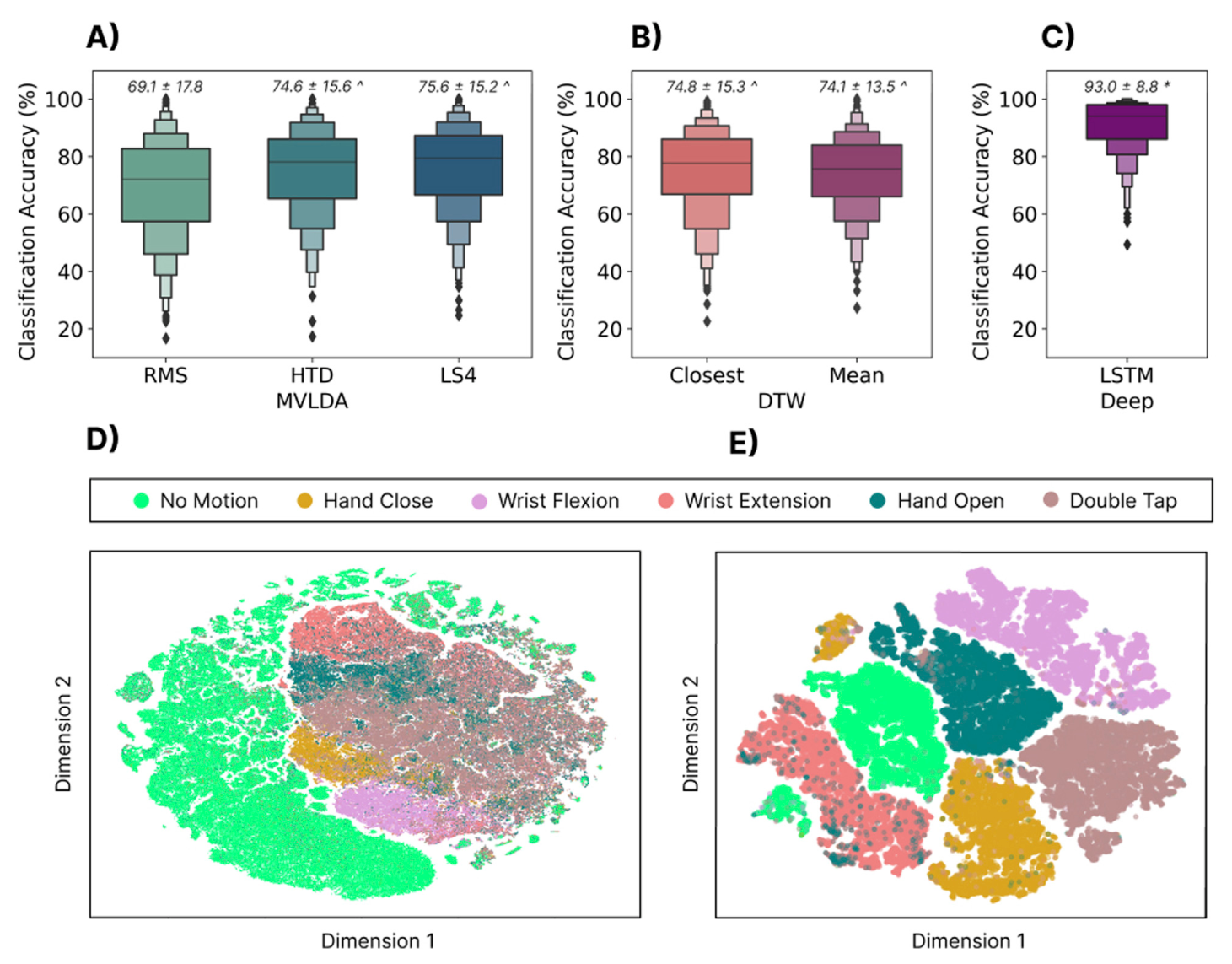
The large cross-user model achieved approximately 93% accuracy on the six-class task. In the 300-user-pool scaling experiment, accuracy first exceeded 90% with 150 users and 30 repetitions per gesture. That is an observed threshold for this model and split, not a universal minimum number of people required for EMG recognition.
Performance was not uniform across users. Analyses of underrepresented demographic groups found disparities, and personal transfer learning improved results, including at the lower end of the participant distribution. Optional calibration therefore remained useful even when average zero-shot recognition was strong.
The model also transferred to the separate same-device dataset with a similar baseline accuracy and resilience to several tested conditions. Slower gestures remained a difficulty. Furthermore, classifier confidence was high for many gestures outside the trained set: confidence rejection alone did not solve unintended-input recognition.
Reading the figures
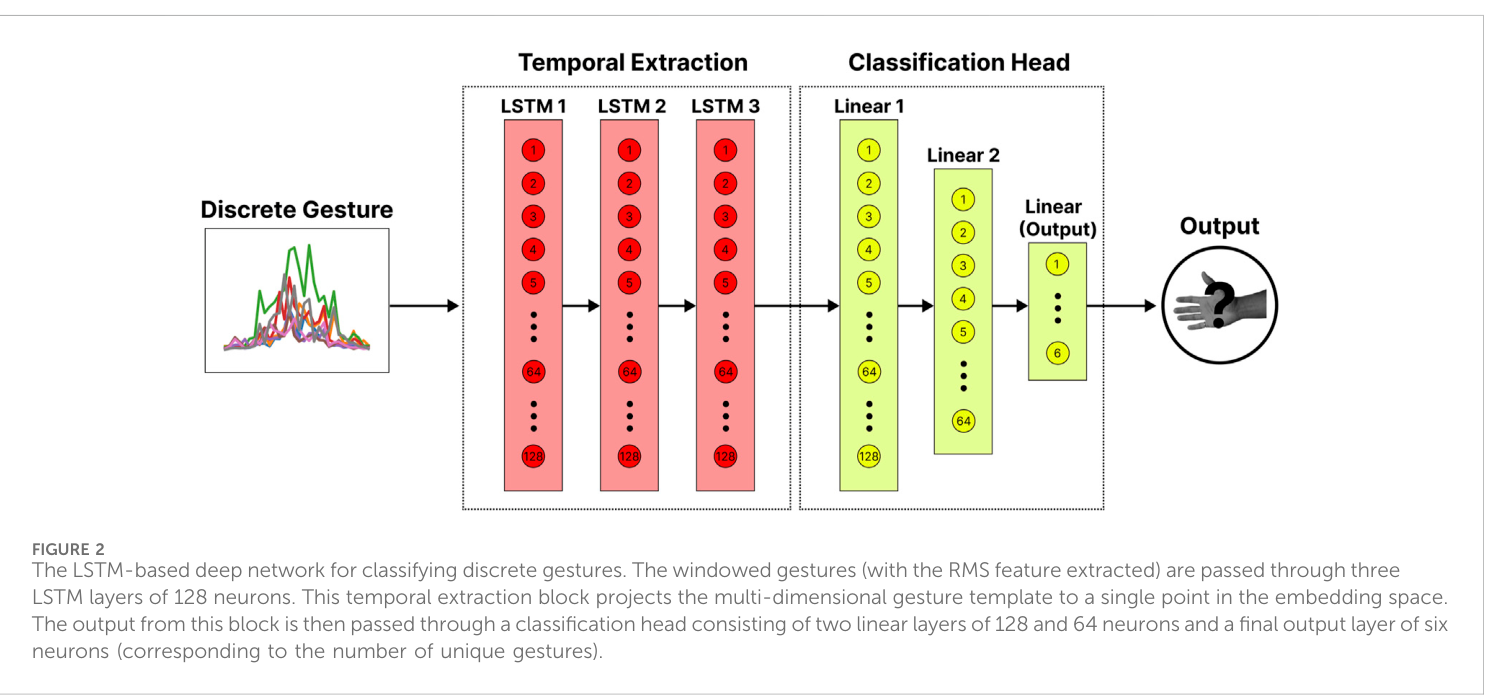
The left side represents a gesture as a sequence of feature values. Successive LSTM layers encode its temporal evolution, and the classification head converts that representation into one output.
This is why the paper’s accuracy concerns complete events rather than individual short windows. The diagram also makes the six-class scope explicit: the network must still decide among its trained outputs when an unfamiliar action reaches it.
The zero-shot comparison shows the distribution over held-out users, not just the mean accuracy. The upper panels compare the model families; the lower panels visualize representations from the analysis. The projections help illustrate class organization, while the classification panels provide the quantitative evaluation. Neither is an always-on false-activation assessment.
What the results do not establish
A successful zero-shot result on segmented gestures does not establish reliable always-on operation amid daily activity. Detecting gesture boundaries and rejecting unrelated movement are additional requirements.
Both datasets used the Myo Armband. The experiment did not demonstrate transfer across arbitrary sensors, and the large training population did not remove demographic differences or every confounding factor. The results concern discrete events rather than simultaneous proportional control.
Looking back
The paper establishes a concrete cross-user result and then examines where it holds. The scaling experiments are useful because they make the training population an explicit experimental variable, while the per-user analyses prevent the average from becoming the entire story.
A focused continuation would preserve the participant-disjoint evaluation while adding deliberate variations in gesture speed and testing an uninterrupted stream of everyday activity. Those experiments would address two specific limitations exposed by this study.
Read further
Ethan Eddy, Evan Campbell, Scott Bateman, and Erik Scheme. Big Data in Myoelectric Control: Large Multi-User Models Enable Robust Zero-Shot EMG-Based Discrete Gesture Recognition. Frontiers in Bioengineering and Biotechnology 12, 1463377, September 23, 2024. DOI: 10.3389/fbioe.2024.1463377.
Section 3.2 gives the main zero-shot comparison. Sections 3.4, 3.6, and 3.8–3.10 address scaling, representation, adaptation, separate-dataset testing, and rejection.