Recognizing an entire gesture sequence adds temporal information, but does it remove the position and session sensitivities familiar from continuous EMG control? This paper measures those effects and adds a distinctly temporal factor: how quickly the gesture is performed.
We compared four recognition architectures under matched baseline and changed conditions. The focus was quantifying each confound and examining whether collecting examples of it during training reduced the resulting loss.
The question
A discrete recognizer returns one command after observing the gesture’s evolution. This can distinguish movements that look similar within one short window, yet also makes the timing of the sequence relevant.
The study asked how well models trained at one position, day, and moderate speed recognized otherwise familiar gestures under a changed condition. It then tested a different question: how much performance returned when training included examples representative of that change.
The study at a glance
- Participants
- Fifteen people recorded in two sessions with an eight-channel Myo Armband.
- Inputs
- Nine dynamic gestures plus a resting recording used for activity thresholding.
- Factors
- Recording day, four additional limb positions, and slower or faster gesture execution.
- Models
- Majority-vote LDA, dynamic time warping, and LSTM networks trained with cross-entropy or contrastive loss.
How we approached it
Each model was trained separately for each participant. Baseline recognition used held-out repetitions from the same condition. Changed-condition tests initially supplied no examples of the new condition during training.
The aggregation analyses then added selected examples from the new day, positions, or speeds, keeping separate repetitions for testing. Comparing those cases establishes what the extra training data recovered, while making its additional acquisition burden explicit.
Technical detail: the evaluation
Gesture segmentation was treated as correct for this evaluation. The reported accuracy measures assignment of a class to a gesture, excluding boundary-detection errors and false detections during unrelated activity.
The factors were introduced separately. Their individual effects do not establish performance when several occur together. The speed instructions asked for approximately 50% faster or slower performance; they were user-executed conditions rather than mechanically imposed motion profiles.
What we found
For the cross-entropy LSTM, day-one baseline accuracy was 95.3%, but training on day one and testing on day two gave 64.3%. DTW achieved 93.7% at the day-one baseline and 76.3% across days. Thus the slightly lower baseline model generalized better in this particular comparison.
Speed changes also reduced accuracy. The same LSTM achieved 79.5% on slower gestures and 81.9% on faster gestures, compared with 95.3% at moderate speed. With representative-speed training data, it achieved 93.1% and 91.6% on held-out slow and fast examples.
Unseen positions generally degraded all models. A specific exception was DTW at position two, where the decrease was not significant. Including representative position data substantially improved the temporal models. These results describe the measured factor and training condition; they should not be collapsed into one generic robustness score.
Reading the figures
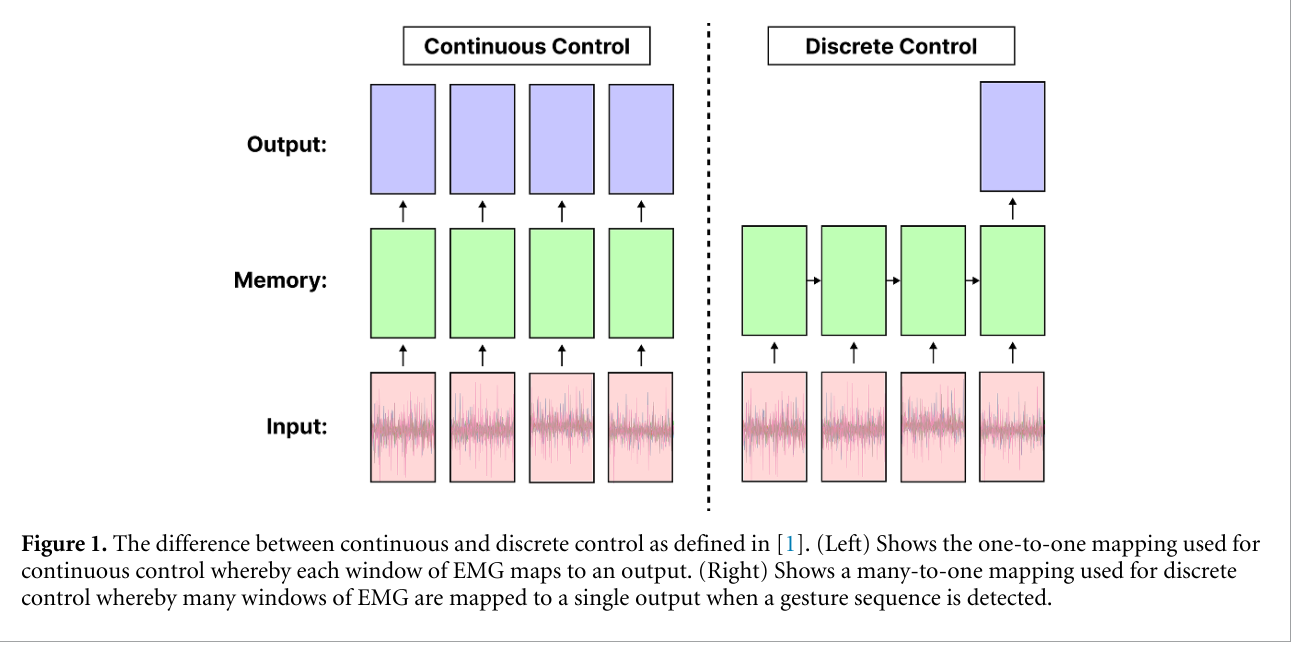
The continuous side pairs each short input window with a decision. The discrete side carries information through the sequence before issuing one decision.
This explains both the opportunity and the speed question. A sequence contains useful ordering information, but changing its timing can alter the pattern a model has learned. The figure defines the recognition unit; the tables measure the confounds.
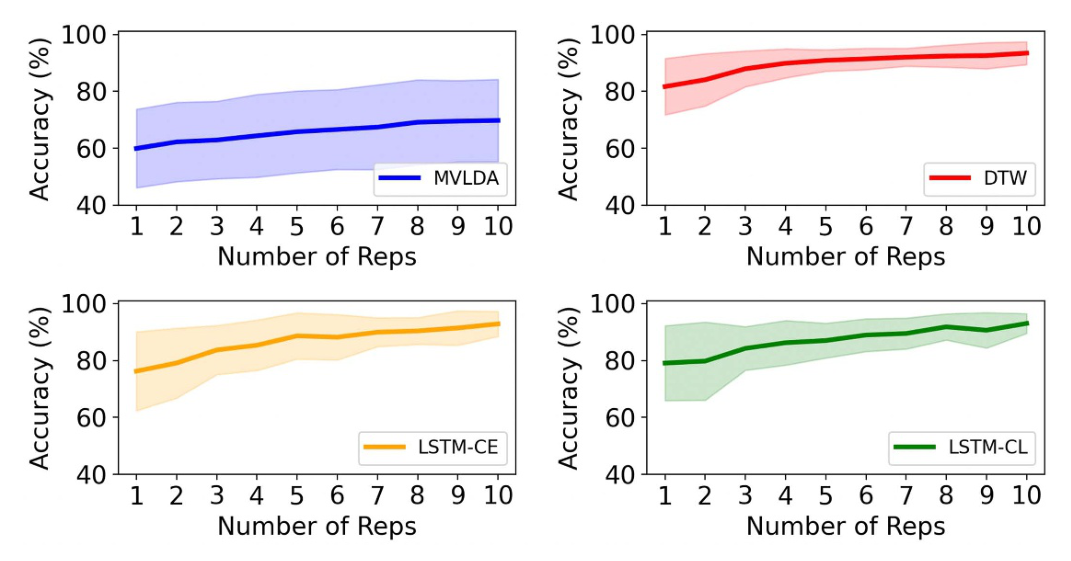
This experiment adds repetitions from the second day to the first-day training data. The four panels show that the benefit and starting point depend on the model. The shaded regions retain participant variability, and the horizontal axis measures added repetitions rather than elapsed time or a completely new-user calibration budget.
What the results do not establish
The models were user-dependent and the experiment used fifteen participants with one device. It does not establish how large cross-user models or other sensor systems respond to the same factors.
The aggregation condition intentionally adds information about the test condition. Its improved accuracy is not evidence of zero-data generalization. The study also excludes the event-detection and unintended-activation problems faced by an always-on interface.
Looking back
The contribution is the factor-by-factor measurement for discrete recognition, especially the explicit speed manipulation. The changed ranking between baseline and cross-day tests shows why model selection should be tied to the condition the model must handle.
A focused extension would test combinations of day, position, and speed, then compare representative-data collection with augmentation under a fixed training budget. Continuous-stream evaluation would add the segmentation errors intentionally excluded here.
Read further
Ethan Eddy, Evan Campbell, Scott Bateman, and Erik Scheme. Understanding the Influence of Confounding Factors in Myoelectric Control for Discrete Gesture Recognition. Journal of Neural Engineering 21, 036015, May 17, 2024. DOI: 10.1088/1741-2552/ad4915.
Tables 2–4 report day, position, and speed separately. Figure 8 examines adding new-day repetitions; the evaluation section specifies that segmentation errors are excluded.