How can a new EMG algorithm be tested across several meaningful problems without rebuilding a separate data pipeline for each one? This paper introduces a dataset collection and benchmarking interface within LibEMG.
The contribution combines eight newly released datasets with thirteen previously published datasets. It supplies documented access, default evaluation splits, and baseline results so that researchers can compare methods across distinct conditions rather than only a convenient single collection.
The question
EMG datasets differ in hardware, channels, sampling rates, gesture sets, labels, and experimental conditions. Reformatting each collection creates overhead and opportunities for inconsistent evaluation.
The paper asks how to standardize that access without pretending all recordings measure the same problem. Its collection spans ordinary gesture classification, known confounds, and regression, allowing model behaviour to be examined across a more explicit range of tasks.
The study at a glance
- Collection
- Twenty-one datasets: eight new releases and thirteen selected existing collections.
- Interface
- Dataset objects prepare training and testing data for the existing LibEMG pipeline.
- Task coverage
- Classification and regression, with factors including position, session, electrode shift, cross-user use, and prompt compliance.
- Baselines
- Conventional linear models and multilayer perceptrons with selected EMG feature sets.
How we approached it
Each dataset wrapper handles its source format and provides the appropriate prepared data and labels. Default training and testing partitions make the evaluation protocol visible and repeatable. A shared evaluation interface then runs a compatible model through the selected datasets.
The framework can refer to externally hosted data rather than requiring every collection to be copied into one repository. This preserves the original sources while providing a consistent entry point. The paper documents each dataset’s participants, acquisition, labels, and intended use.
Technical detail: the evaluation
The baseline analyses used 200 ms windows advanced every 50 ms and the default dataset splits. Classification used LDA and a multilayer perceptron; regression used linear regression and an analogous neural model.
The neural baseline was not exhaustively optimized for every dataset and feature combination. These results are starting points for reproducible comparisons, not a definitive ranking of all model families.
What we found
The baseline tables show that model and feature performance varies across tasks. Classification results are reported as accuracy, while regression results use mean absolute error; those values cannot be combined into a single unqualified score.
The prompt-compliance regression dataset illustrates why the collection includes more than conventional gesture recordings. With Hudgins time-domain features, linear regression had a mean absolute error of 0.3008, compared with 0.1649 for the neural regressor under the dataset’s specified evaluation. This result concerns emulated training-behaviour mismatches, not every regression task.
The evaluation also exposed a computational limitation: the high-dimensional RMS phasor feature representation was impractical for the high-density regression analyses, requiring 65,820 features per window in the cited case. A useful benchmark can reveal memory and representation limits as well as prediction errors.
Reading the figures
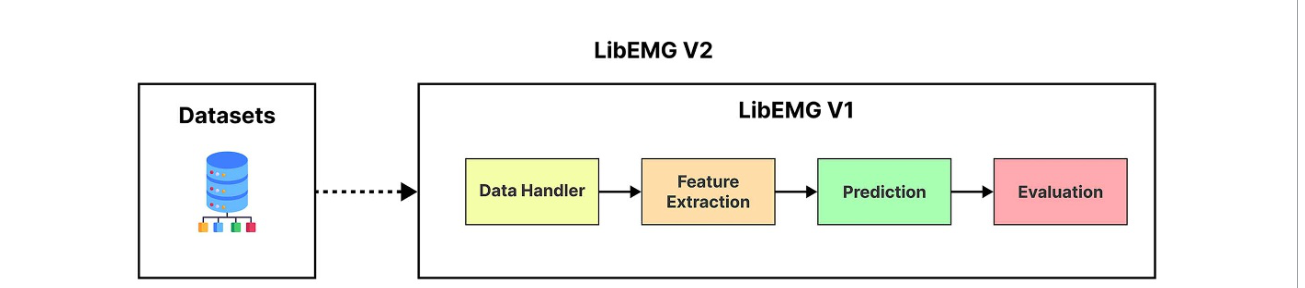
The outer extension brings dataset preparation into the same workflow as processing and evaluation. The inner pipeline remains recognizable from the original library.
The diagram describes a common interface, not a pooled training set. A cross-session split and a within-user repetition split still answer different questions even when the same evaluation function executes both.
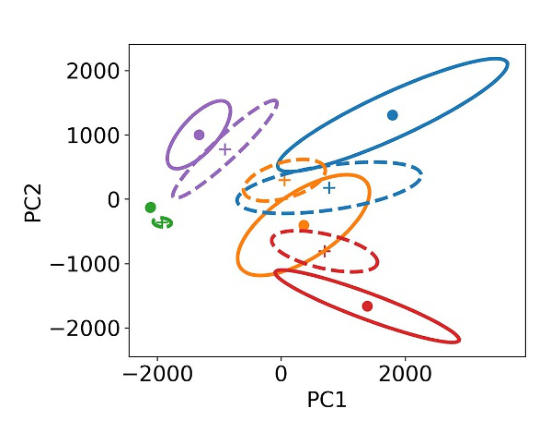
The electrode-shift dataset provides a concrete example of why the benchmark separates evaluation problems. This PCA view shows changes in the recorded feature distributions after a 45-degree shift. It motivates a shift-specific test; it is neither a summary of all 21 datasets nor a universal ranking of algorithms.
What the results do not establish
Standardized access cannot remove differences in populations, hardware, or label quality. Results remain conditional on each dataset’s acquisition and split, and offline benchmarks do not directly measure live usability.
The collection is broad but finite. It does not establish coverage of every prosthesis use case, and the baselines are intentionally modest. The paper’s reported collection and APIs also describe a particular release, not a permanent limit on the maintained library.
Looking back
The specific contribution is reproducible access to a set of distinct evaluation problems. It is strongest when researchers retain that distinction and report which conditions improve or worsen, rather than averaging away the differences.
A focused continuation would add reproducible compute and latency measurements beside prediction metrics, and connect selected offline tasks to corresponding online evaluations. That would test both computational practicality and how well each benchmark predicts the control behaviour it is meant to represent.
Read further
Ethan Eddy, Evan Campbell, Christian Morrell, Heather Williams, Scott Bateman, and Erik Scheme. Raising the Standard: An Open Source Benchmarking Platform and Data Repository to Accelerate Myoelectric Control Research. Machine Learning: Health 1, 010601, July 31, 2025. DOI: 10.1088/3049-477X/ade549.
Section 3 documents the datasets. Tables 1–3 provide classification and regression baselines, while the discussion explains coverage and computational limits. The current library documentation is available through libemg.com.